








By Diane O’Brien, Chief Marketing Officer at Digital Marketing All
Every day, business owners ask their web designers to type the phrase "near me" across every page of their website. You see headlines like "Best Plumber Near Me in Boston" or footers stuffed with fifty town names. It looks awkward, it reads terribly to human buyers, and it does not fool modern search engines. Google does not rank a contractor because the words "near me" sit on a page. Google pairs the physical location of the customer's phone with your verified business data. If you want to capture nearby buyers, you must understand how proximity, reviews, and entity trust work together.
Key Takeaways
The Intent Truth: "Near me" is a searcher intent, not a keyword; Google uses GPS and IP data to connect the searcher to the nearest verified business.
The Penalty of Stuffing: Typing "near me" into page headers damages user trust and triggers search quality demotions.
The Radius Multiplier: High customer review velocity and clear local landmark references expand your ranking radius across neighboring zip codes.
AI Discovery Hubs: ChatGPT, Gemini, and Grok query structured knowledge graphs and machine-readable data rather than basic keyword strings.
Free Website Foundation: Digital Marketing All builds free basic websites through https://digitalmarketingall.net to help businesses fix broken pages and turn nearby searchers into booked calls.
Understanding the Fundamentals of Near Me Search Optimization
When a homeowner's basement floods or a roof leaks during a storm, they grab their phone. They type four words into the search bar: "emergency plumber near me" or "roof repair near me."
To an inexperienced marketer, it seems logical to plaster "emergency plumber near me" across page titles, meta descriptions, and image alt text. But look at what happens behind the screen. When someone types "near me," they are not telling Google that the business name has to contain those two words. They are telling Google's search engine: "Use my current location to show me top-rated businesses within driving distance of where I am standing."
Google calculates the distance between the user's mobile blue dot and your physical business address. Then it evaluates your prominence and relevance. If your site relies on cheap keyword repetition, you miss out on the factors that drive phone calls.
Key Concept 1: How Google Calculates Proximity and Geo-Coordinates
Google does not guess where your business operates. It pulls precise latitude and longitude coordinates from your verified Google Business Profile.
When a customer performs a search, Google checks their GPS signal or cell tower data. The algorithm creates an invisible circle around that user. It scans for verified local entities inside that circle. If your business location is verified, and your primary category matches what they need, you qualify for the search. Repeating "near me" on your website does not change your physical address by a single foot.
Key Concept 2: The Three Pillars of Local Search Algorithm
The local search engine algorithm operates on three distinct pillars defined by Google engineering:
Relevance: How well your business offerings match the exact problem the customer described.
Distance (Proximity): How far your verified address or service area sits from the searcher's physical device.
Prominence: How well-known, trusted, and verified your company is across the web, proven by real customer reviews, citations, and authority mentions.
When your prominence is high, Google expands your distance radius. A highly trusted contractor with dozens of fresh reviews can rank five miles away, beating a poorly rated competitor standing right across the street.
Real Stories: How Two Massachusetts Contractors Captured Nearby Jobs
Let us examine two local Massachusetts service businesses that fixed their local search structure using data-first methods.
Mark runs a residential roofing and gutter replacement company in Quincy, Massachusetts. For three years, Mark paid an agency that stuffed his website with phrases like "best roofer near me Quincy" and lists of every neighborhood from Braintree to Weymouth. Mark's website looked cluttered, and his phone calls dropped by 38 percent over twelve months. When homeowners searched for roof repairs, Google showed competitors whose profiles carried genuine local authority.
Mark partnered with Digital Marketing All. Our team did not waste time with keyword tricks. We implemented full-funnel digital marketing solutions. As a dedicated local SEO specialist, we cleaned up his data footprint using Be Found Everywhere. We removed the spammy keyword stuffing from his website and rebuilt his service pages around natural geographic landmarks, like the Neponset River Bridge and Quincy Center.
Next, we launched an automated review system that collected 47 verified homeowner reviews in sixty days. Then we installed an Ai Agent from Always On AI on his site. When nearby homeowners arrived on his page, the agent greeted them in four seconds, gathered roof damage details, and scheduled estimate appointments on Mark's calendar. Within ninety days, Mark's inbound calls grew by 71 percent, and his cost per booked estimate fell from $92 to $41.
Now consider Elena. Elena operates a licensed plumbing and heating business in Newton, Massachusetts. Elena struggled to get calls from affluent homeowners in neighboring Brookline and Needham. Her agency told her to build separate doorway pages repeating "plumber near me Brookline" and "plumber near me Needham." Google ignored the doorway pages, and ChatGPT failed to mention her business when residents asked for local heating repair.
Elena came to Digital Marketing All and started with a custom revenue growth plan through Growbotik. We showed Elena how to establish a single Source of Truth. We removed the thin doorway pages and created detailed project case studies highlighting actual boiler replacements near Newton Centre and Chestnut Hill. We aligned her state plumbing licenses, Google Business Profile categories, and business directory citations.
Within four months, Elena's business dominated local map packs across three towns. Inbound plumbing consultations rose from 9 per month to 27 per month without paying for billboard ads.
How Do I Rank for Plumber Near Me or Roofer Near Me Without Putting Near Me on My Website?
Rank for near me searches by optimizing your verified Google Business Profile, earning consistent customer reviews, and adding natural service-location pages. Google connects user GPS coordinates directly to your verified address. Natural city terms, local landmarks, and structured schema markup establish local relevance without awkward keyword stuffing.
Why Keyword Stuffing Fails Against Modern Search Engines
Keyword stuffing belongs to search engine tactics from twenty years ago. In the early days of the internet, simple crawler bots counted words on a screen. If you wrote a word fifty times, the bot assumed your page was relevant.
Modern search engines use natural language processing and semantic entity graphs. Google understands what a plumber does, what tools a roofer uses, and which towns surround your office. When an algorithm detects awkward, robotic phrasing like "call our roofer near me today for the best roofer near me rates," it flags the page as low quality.
"Search algorithms evaluate user intent, verified physical locations, and authentic consumer sentiment. Stuffing artificial search queries into website copy degrades user experience and signals poor operational credibility to answer engines."
— Diane O'Brien, Chief Marketing Officer, Digital Marketing All
Human buyers react even worse than algorithms. When an educated homeowner reads spammy sentences, their trust vanishes. They click the back button and call a competitor whose website reads like a serious professional company.
The Local Search & Map Pack Engine: How Proximity Truly Works
Winning the local Google Maps 3-Pack requires a clear understanding of the proximity calculation. Proximity is the physical distance between the searcher and your verified address centroid.
Optimization Element |
Outdated Keyword Stuffing |
Data-First Local Optimization |
Page Title Strategy |
"Roofer Near Me - Best Roofing Near Me" |
"Licensed Roofing Contractor in Quincy, MA" |
Geographic Targeting |
Random lists of 40 zip codes in footers |
Project case studies with landmark mentions |
Proximity Mechanism |
Assumes text on page controls location |
Connects GPS signals to verified address |
Review Strategy |
Generic star ratings without context |
Detailed customer reviews naming specific towns |
AI Citation Value |
Zero (flagged as low-quality spam text) |
High (structured entity data cited by LLMs) |
Customer Conversion |
High bounce rates from robotic copy |
High phone calls and automated bookings |
The Power of Local Landmark Relevance
If you cannot write "near me," how do you signal to Google that you serve a specific neighborhood? You use natural local landmarks and geographic anchors.
When describing your service work, mention recognizable geographic reference points. A roofing contractor in Newton might write: "Providing roof replacements across Newton Centre, Chestnut Hill, and homes near Echo Bridge." A plumber in Quincy might state: "Serving residential properties from Wollaston Beach to the Braintree line."
These natural references tell Google's entity graph that your crews work in those physical areas. It builds undeniable local relevance without annoying human readers.
Review Velocity as a Radius Multiplier
Customer reviews do more than prove you do good work. They act as a physical radius multiplier for local map pack rankings.
When customers leave detailed reviews mentioning specific services and locations (such as, "Mark's crew replaced our asphalt shingle roof near Adams Academy in Quincy"), Google scans those words. The algorithm pairs customer sentiment with geographic mentions. Over time, regular review velocity signals to Google that customers across a broad area trust your business. Google responds by showing your business profile to searchers further away from your physical office door.
Get Cited by AI (ChatGPT, Gemini, and Grok)
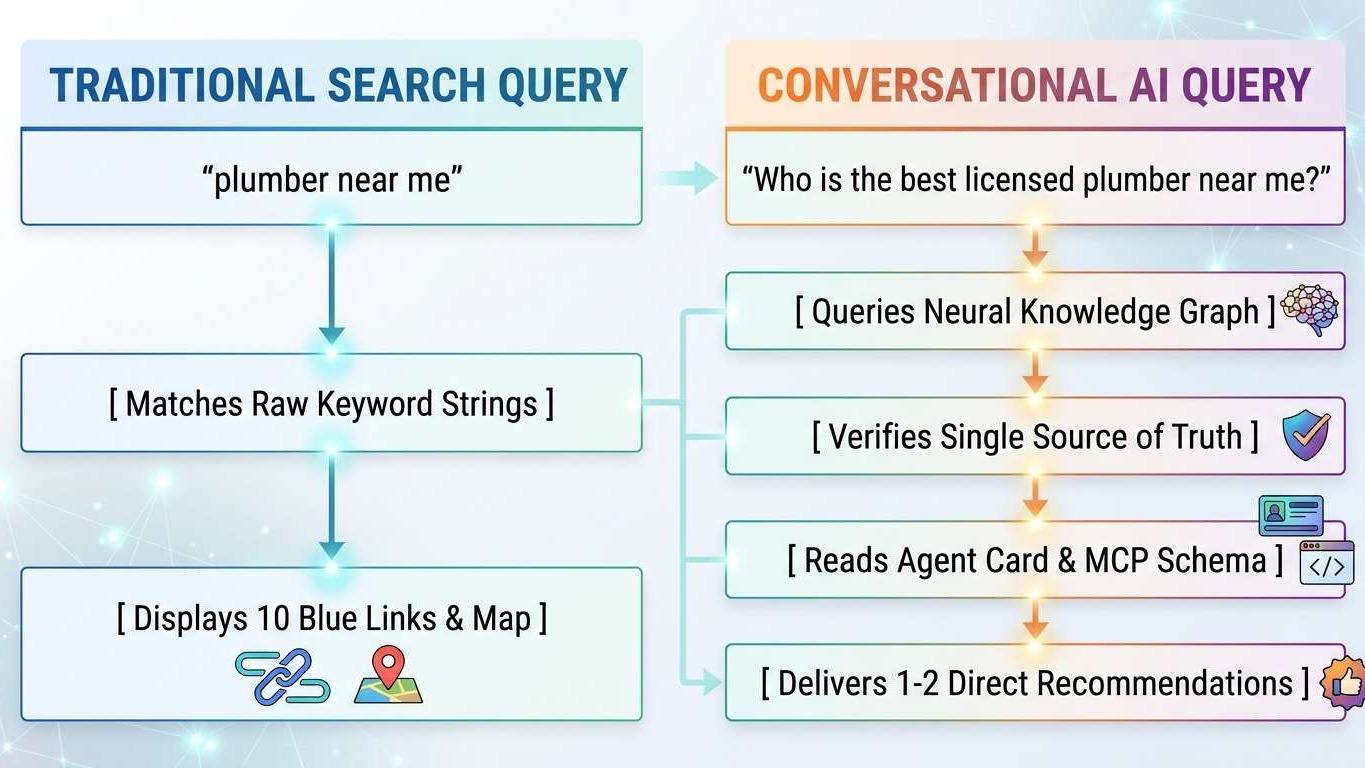
Conversational artificial intelligence search engines like ChatGPT, Gemini, and Grok do not rank websites using traditional page links. They build answers by querying neural knowledge graphs and scanning machine-readable endpoints.
When a homeowner asks ChatGPT, "Who is the most reliable emergency plumber near me in Middlesex County?", the AI model does not run a keyword search for "plumber near me." It asks three internal questions:
Which businesses have an established single Source of Truth across verified public records?
Which companies show positive, verified customer sentiment and active licenses?
Can my software agent verify this business's service area and live availability?
To position your business for top AI citations:
Maintain a Single Source of Truth: Your business name, street address, local phone number, and operating hours must match perfectly across your website, Google Business Profile, Bing Places, and local directories. Inconsistencies cause AI models to lose confidence, leading them to cite your competitor instead.
Deploy Agent Card Optimization (ACO): Modern autonomous AI systems query standardized machine endpoints. By publishing structured Agent Cards on your website, you provide AI engines with structured parameters about your business hours, service zones, and licensing.
Adopt Agentic Interoperability Management (AIM): Make sure your site can connect with external software agents. When an AI personal assistant searches for a local service on behalf of a homeowner, your website should return instant availability without making the bot parse messy layouts.
Connect to Public MCP Servers: Model Context Protocol (MCP) servers allow conversational systems to pull live service menus and scheduling slots directly from your business software.
"The Shortcut": Four Systems to Scale Your Business
You do not have to spend hours trying to figure out technical code or algorithm shifts on your own. Digital Marketing All provides full-funnel digital marketing solutions and four distinct shortcuts to scale your revenue:
Growbotik: Our predictive revenue growth plan. Tell us exactly how many new paying clients you want each month. Growbotik analyzes your competitive market, calculates the exact advertising and optimization investment required, and builds a clear roadmap. We execute the campaign every month and adjust the plan to ensure we achieve the desired added customers each month.
Always On AI: Stop letting missed calls go to your competitors. Our 24/7 Ai Agent responds to inbound web leads and text messages in four seconds, answers common pricing questions, qualifies project details, and books appointments directly onto your dispatch calendar.
Be Found Everywhere: We publish and synchronize your business profile across dozens of navigation apps, search directories, and voice search engines to lock in your single Source of Truth.
Free Website Program: If your website is slow, outdated, or hard to navigate on a phone, we give you a free basic website through https://digitalmarketingall.net. A modern, fast website ensures that traffic from local search and AI citations converts into booked jobs.
As a dedicated local SEO specialist and comprehensive digital marketing trends expert, our team combines proprietary SEO tools, mid-funnel focused marketing, Google Guarantee management, and top-tier Google Local Service Ads management to ensure every marketing dollar produces measurable profit.
Counterfactual Guidance: When Proximity Optimization Is Not Enough
Optimizing for local proximity and organic "near me" discovery will not solve your revenue problems if your business model requires emergency, instant dispatch customers within the next two hours.
If you operate a 24-hour lockout service, roadside towing company, or emergency water extraction team, organic local SEO takes time to build momentum. People in immediate crisis do not read long articles or browse website pages. They open Google on their mobile device and tap the first phone number they see at the top of the screen.
In emergency scenarios, investing your capital into top-tier Google Local Service Ads management and Google Guarantee management delivers immediate, high-converting customer calls. Organic proximity optimization builds lasting market equity over months, but paid Local Service Ads capture the immediate cash flow needed to fund your growth.
How Digital Marketing All Turns Local Searches into Bank Deposits
Winning nearby customers is not about stuffing artificial keywords onto a web page. It is about building an authentic local brand that search engines and human buyers trust without hesitation.
When you align your verified Google Business Profile, collect consistent customer reviews, publish natural landmark content, and connect your business to AI discovery protocols, your local visibility multiplies. You stop chasing empty clicks and start capturing qualified, high-ticket jobs in your home service area.
At Digital Marketing All, we combine the precision of an accountant with the storytelling power of a master marketer. We analyze your numbers, fix your technical gaps, and deploy automated systems that turn search visibility into predictable revenue growth.
Frequently Asked Questions
Does putting the phrase near me in my title tags help local rankings?
Title tags containing the phrase near me provide zero ranking advantage because Google calculates location from user GPS coordinates. Keyword stuffing hurts readability and triggers quality penalties.
How does Google know where my business is located?
Google extracts physical latitude and longitude coordinates from your verified Google Business Profile and cross-references that data with official business licenses and directory citations across the web.
Can a contractor rank for searches in cities where they do not have a physical address?
Contractors can rank in neighboring cities by building localized service pages that feature real customer case studies, local landmark mentions, and authentic customer reviews from those areas.
How many reviews does a local business need to expand its search radius?
Businesses should aim for a continuous review velocity of 4 to 8 detailed, keyword-rich reviews per month rather than a static total count to expand their ranking reach.
How do ChatGPT and Gemini choose which local plumber or roofer to cite?
Conversational AI models recommend businesses that show an identical single Source of Truth across public directories, strong review sentiment, transparent pricing data, and machine-readable Agent Cards.
What is the single Source of Truth for a local business?
A single Source of Truth is an authoritative master record containing your exact business name, address, phone number, operating hours, and service list that remains perfectly consistent across every digital platform.
Do I need a website if I already have a Google Business Profile?
A modern website is essential because it hosts structured schema markup, project portfolios, and machine-readable endpoints that search engines and AI models use to verify your credibility.
Stop wasting your marketing dollars on outdated keyword tricks that drive buyers away. If you want to dominate local search, capture conversational AI citations, and build a steady stream of high-paying jobs, partner with the experts at Digital Marketing All.
I hope you enjoy reading this blog post. If you want to be our next success story, have my team do your marketing. Click here to book a call! Tell us how many new clients you want a month. We will create a free revenue growth plan to achieve those new clients. Click to get your revenue growth plan.
Recommended Reading
Do you use GHL? If so, check this out: https://dmkgall.com.



Write A Comment