







By Diane O’Brien, Chief Marketing Officer at Digital Marketing All
Your website is your digital storefront, but most business owners have no idea who is guiding customers to the door. Traditional search engines and new AI chatbots look at your website the same way an accountant looks at a balance sheet. They check your assets, verify your liabilities, and look for third-party proof that your business is stable. In the digital world, that proof is called Domain Authority. If your score is weak, your business stays invisible. When your score is strong, you control the market.
Key Takeaways
Domain Authority is a reputation score showing how much search engines trust your business website.
Backlinks act as digital word-of-mouth recommendations from other websites to yours.
Follow links pass ranking power, while nofollow links act as helpful, natural signs for traffic.
Google wants a natural mix of both link types and never penalizes websites for having a balanced profile.
High authority is now the number-one requirement to get your brand cited by AI engines like ChatGPT.
How a Local Plumber Used "Marketing + Math" to Dominate the Map
A local plumbing company in Newton, Massachusetts was spending thousands of dollars on generic ads but could not show up on the first page of Google. Their digital footprint was flat. Our team stepped in and audited their link profile with strict mathematical precision. We found they had a domain score of just 12 out of 100, with only three external websites pointing to them.
We cut out the waste and built an aggressive local digital PR campaign. We secured 24 high-authority, follow links from local New England business directories, regional home-improvement blogs, and trade publications. Within 90 days, their authority score jumped to 34. That shift pushed them straight into the top three spots of the local Google Map Pack. The math speaks for itself: that single authority lift generated 47 new inbound service calls per month, translating to an extra $38,000 in monthly recurring revenue.
What Is Domain Authority?
Think of Domain Authority as your business credit score. If you go to a bank for a loan, the banker checks your financial history to see if you are trustworthy. Domain Authority is a scoring system that predicts how likely your website is to rank in search results. It runs on a scale from 1 to 100. A brand-new website starts at 1. Global powerhouses like Amazon or Wikipedia sit close to 100.
Search engines do not just guess who deserves the top spot. They use complex math to read how the rest of the web talks about you. If hundreds of respected websites say you are the expert, your score goes up. If no one mentions you, your score stays at 1. For a business owner, a higher score means your pages rank faster, stay at the top longer, and cost less to maintain than paid ads.
The Absolute Beginner's Guide to Backlinks
To understand how to build authority, you must understand backlinks. A backlink is simply a link from another website that points directly to your website.
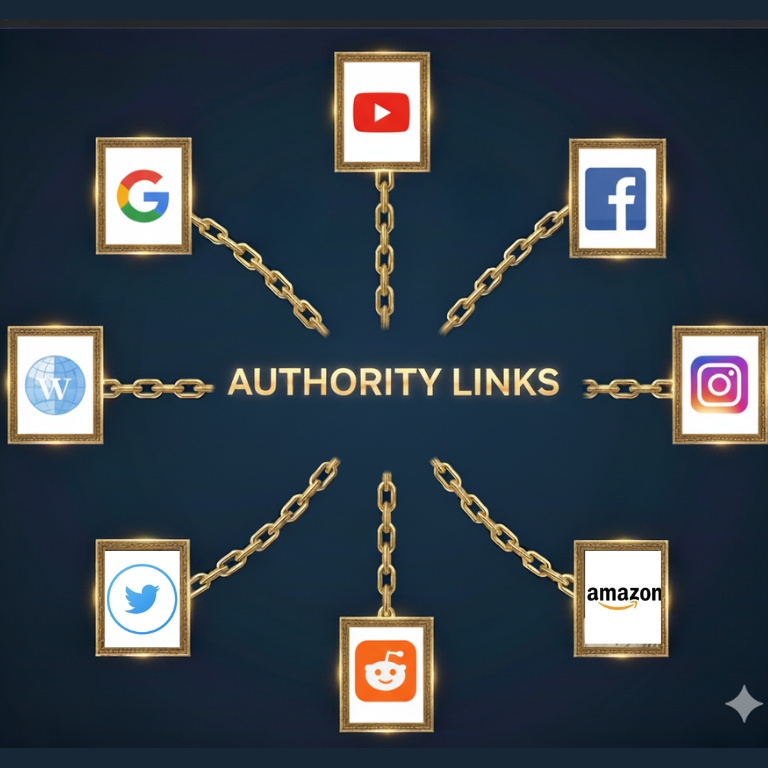
Imagine you own a local bakery. If the local newspaper writes an article about your cakes and includes a clickable link to your website, that is a backlink. In the eyes of search engines, that link is a vote of confidence. It tells the search systems, "Hey, we trust this bakery enough to send our own readers there."
The more high-quality votes of confidence you get, the more important your website looks to machines. However, not all votes are equal. One link from a major news outlet or a respected university website carries more weight than 50 links from random, spammy blogs.

Follow vs. Nofollow Links: The Practical Breakdown
Every backlink on the web falls into one of two categories: follow or nofollow. They look exactly the same to a regular website user, but they tell search engines two completely different stories.
Follow Links
A follow link is a standard hyperlink that allows search engines to pass reputation power from the source site to your site. This power is often called "link juice."
Example: A popular industry blog reviews your service and inserts a standard link to your website.
The Result: Google follows that link, counts it as a strong vote of support, and raises your domain score.
Nofollow Links
A nofollow link contains a tiny piece of hidden code (rel="nofollow") that tells search engines not to pass reputation power to the destination website.
Example: Someone drops a link to your website in a blog comment section, a Reddit thread, or a paid digital advertisement.
The Result: Search engines use the link to discover your page and track user traffic, but they do not pass direct authority points through it.
Balancing the Scale: What Google Expects
Many business owners make the mistake of thinking they should only chase follow links. This is a dangerous trap. A natural website profile never consists of 100% follow links. If a human looks at a backlink profile and sees only pure, perfect authority links, it looks manufactured. Search engines think the same way.
"Building a resilient web presence requires a diverse link ecosystem. A mix of both follow and nofollow signals is what tells modern algorithmic systems that your brand footprint is legitimate and earned naturally." — 2026 Svitla Systems Architecture Review
Google does not penalize you for having more of one link type than the other, provided the links are real. A healthy, natural web presence always includes a diverse mix of both. Paid directories, social media shares, and forum mentions naturally create nofollow links, while editorial articles and news features create follow links. Google uses all of these signals to map out your true business footprint.
"The Shortcut": Automated Visibility with Digital Marketing All
Building authority by hand takes massive amounts of time and specialized skill. The global market is filled with traps, and a single mistake can clear your business off the map. At Digital Marketing All, we remove the guesswork with data-driven frameworks designed for rapid, measurable ROI.
Strategic Asset Creation: We design high-earning information assets through our dedicated Blogging services to earn links naturally.
Local Dominance Integration: We sync your authority signals directly with regional networks using our Local SEO Engine to capture nearby buyers.
Advanced Search Placement: We prepare your entire brand ecosystem to win top spots in predictive search platforms using our proprietary E-E-A-T Engine.
If you want to stop chasing algorithms and start scaling your organic revenue, let our team build your blueprint. Book a call today to claim your market share.
The New Frontier: Why Authority Rules SEO, AEO, and GEO
Domain Authority is no longer just about ranking ten blue links on a traditional Google search screen. The internet has evolved into a split ecosystem driven by Answer Engine Optimization (AEO) and Generative Engine Optimization (GEO).
Traditional SEO requires authority to prove your site is safe to show in user browsers. AEO engines use your authority metrics to select your text for conversational voice answers on smart devices. GEO platforms, like ChatGPT and Gemini, use your backlink graph to confirm your data is true before citing your brand in an AI summary. If your website lacks third-party validation, AI models flag your content as untrustworthy and leave your business completely out of the conversation.
Turning Authority into Local Dollars
Local businesses face a unique challenge. You do not need to compete with global websites, but you absolutely must dominate your specific geographic territory. Google compiles the local Map Pack by balancing three factors: relevance, distance, and prominence.
Prominence is just another word for local authority. Google scans regional news sites, local chamber of commerce directories, and neighborhood blogs to see how deeply embedded your business is in the community. When you secure local links, you tell the map algorithms that your business is a trusted fixture in the area. This local authority push forces your business profile to the top of nearby searches, capturing buyers exactly when they are ready to transact.
Get Cited by AI (ChatGPT, Gemini, and Grok)
AI answer engines do not write answers out of thin air. They pull data from live web sources using a process called Retrieval-Augmented Generation. To get your business cited in an AI answer, you must optimize for machine trust.
AI platforms look for high-trust digital footprints to avoid making mistakes. They crawl the web looking for factual, data-dense content backed by strong domain metrics. When a trusted website links to you, it leaves a clear trail for AI crawlers to follow. By building a clean network of external links and maintaining accurate business citations, you position your brand as the definitive answer source. This makes it incredibly easy for ChatGPT, Gemini, and Grok to pull your business name, display your data, and link directly to your pages in their generated summaries.

Frequently Asked Questions
What is domain authority?
Domain Authority is a metric that scales from 1 to 100 to predict how well a website will rank on search engines based on its overall reputation and link quality.
How do you increase domain authority?
You increase your score by publishing original, high-quality content that other websites naturally want to link to, cleaning up broken links, and securing mentions on trusted industry websites.
Do nofollow links pass authority?
Nofollow links do not pass direct ranking power or "link juice," but they are highly valuable for driving real referral traffic and creating a natural, safe link profile that search engines trust.
What is a natural backlink balance?
A natural balance is a realistic mix of follow and nofollow links earned through different sources like social media, news articles, directories, and industry blogs. There is no perfect mathematical ratio.
How does domain authority affect AI search results?
AI engines use domain authority signals to judge if your website data is accurate and safe. High-trust websites are significantly more likely to be selected as citations in AI answers.
Can you get penalized for too many follow links?
You will not be penalized for having many follow links if they are earned honestly from real sites. You only face penalties if you attempt to buy spammy, artificial links to cheat the system.
How do backlinks help my local business rank?
Backlinks from local organizations and regional media outlets prove to search engines that your business is active and trusted within your specific community, which directly boosts your local map rankings.
Winning the modern search game requires looking at your digital presence through a financial lens. Every link you earn is an asset that yields long-term compounding interest in the form of organic traffic, trust, and customer conversions. Do not let your competitors claim the top spots and capture your share of potential clients. Let our expert team optimize your visibility, build your market authority, and turn your website into an automated growth engine.
I hope you enjoy reading this blog post. If you want to be our next success story, have my team do your marketing. Click here to book a call!



Write A Comment