







By Diane O’Brien, Chief Marketing Officer at Digital Marketing All. | Published on November 14, 2026
You probably spent thousands of dollars over the last few years chasing website backlinks. Maybe an agency sold you monthly link packages, or you paid for guest posts on random blogs just to push your domain score up a few points. That old playbook worked great when buyers typed two words into Google and clicked blue links. Today, your best customers open ChatGPT, Google AI Mode, or Gemini and ask full questions about who to hire. When those AI engines decide which company to recommend, they mostly ignore your backlink count and look straight at who is talking about your brand on YouTube.
Key Takeaways
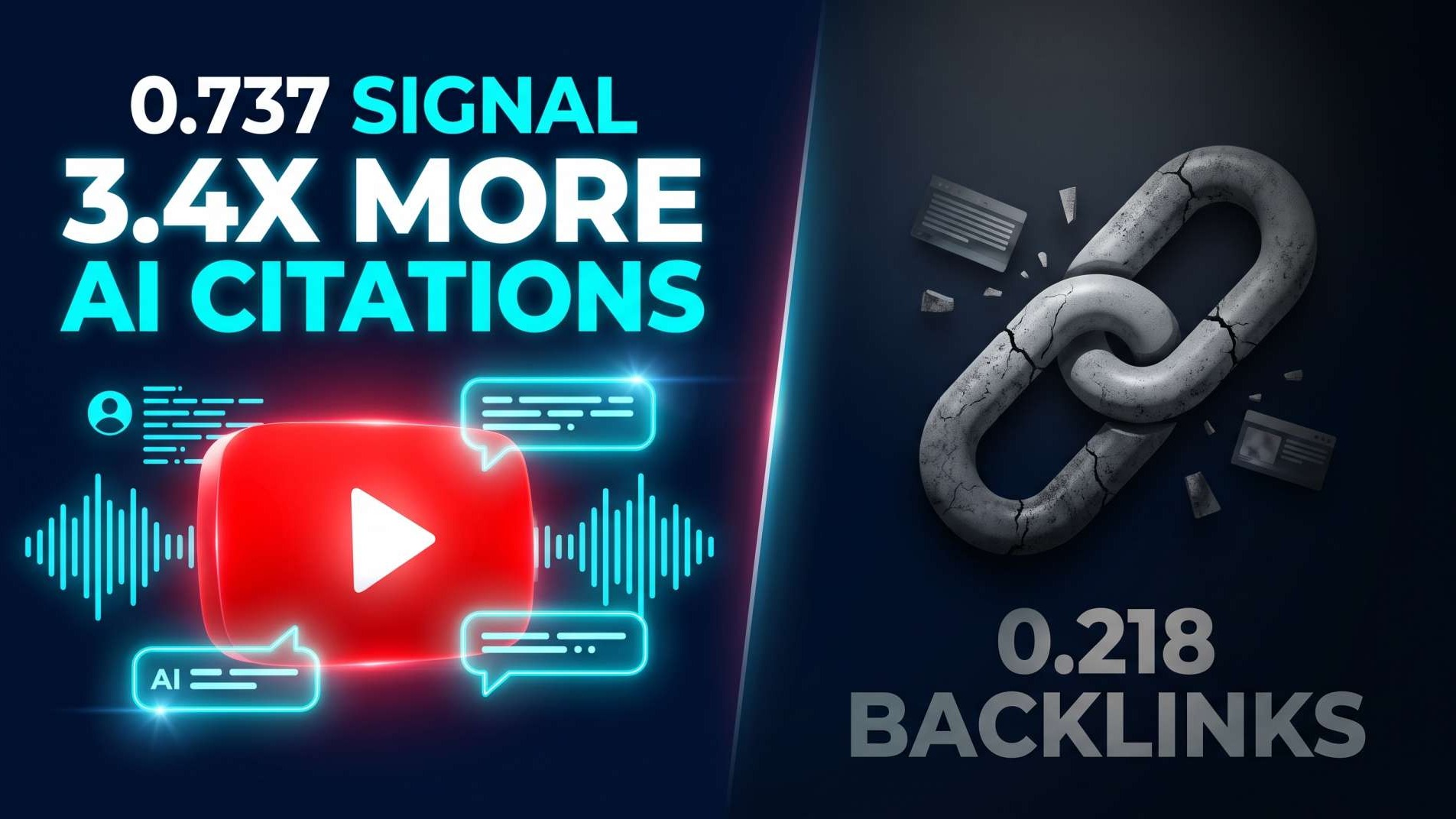
The 0.737 Signal Beats Backlinks: A study of 75,000 brands by Ahrefs proved that YouTube mentions correlate at 0.737 with AI search visibility, beating traditional backlinks (0.218) by 3.4x.
Views Do Not Matter to AI: OtterlyAI found that 40.83% of YouTube videos cited by AI engines have fewer than 1,000 views. Small local channels win citations just as easily as big brands.
Long-Form Video Wins: 94% of AI video citations come from regular long-form YouTube videos rather than Shorts because AI bots pull answers directly from spoken transcripts and detailed descriptions.
Spoken Context Is King: AI models look for your business name spoken out loud within 5 to 10 words of what you sell and where you work.
Unify Your Source of Truth: When your YouTube transcripts, Google Business Profile, and website share the exact same facts, AI agents trust your company enough to send you ready-to-buy leads.
Understanding the Fundamentals of the 0.737 Signal in AI Search
For twenty years, search engines treated the internet like a popularity contest measured by links. If Website A linked to Website B, Google counted that link as a vote of trust. Naturally, marketers figured out how to buy, trade, and fake those votes. By 2025, link graphs became noisy and unreliable. Search engines needed a better way to tell real experts apart from link buyers.
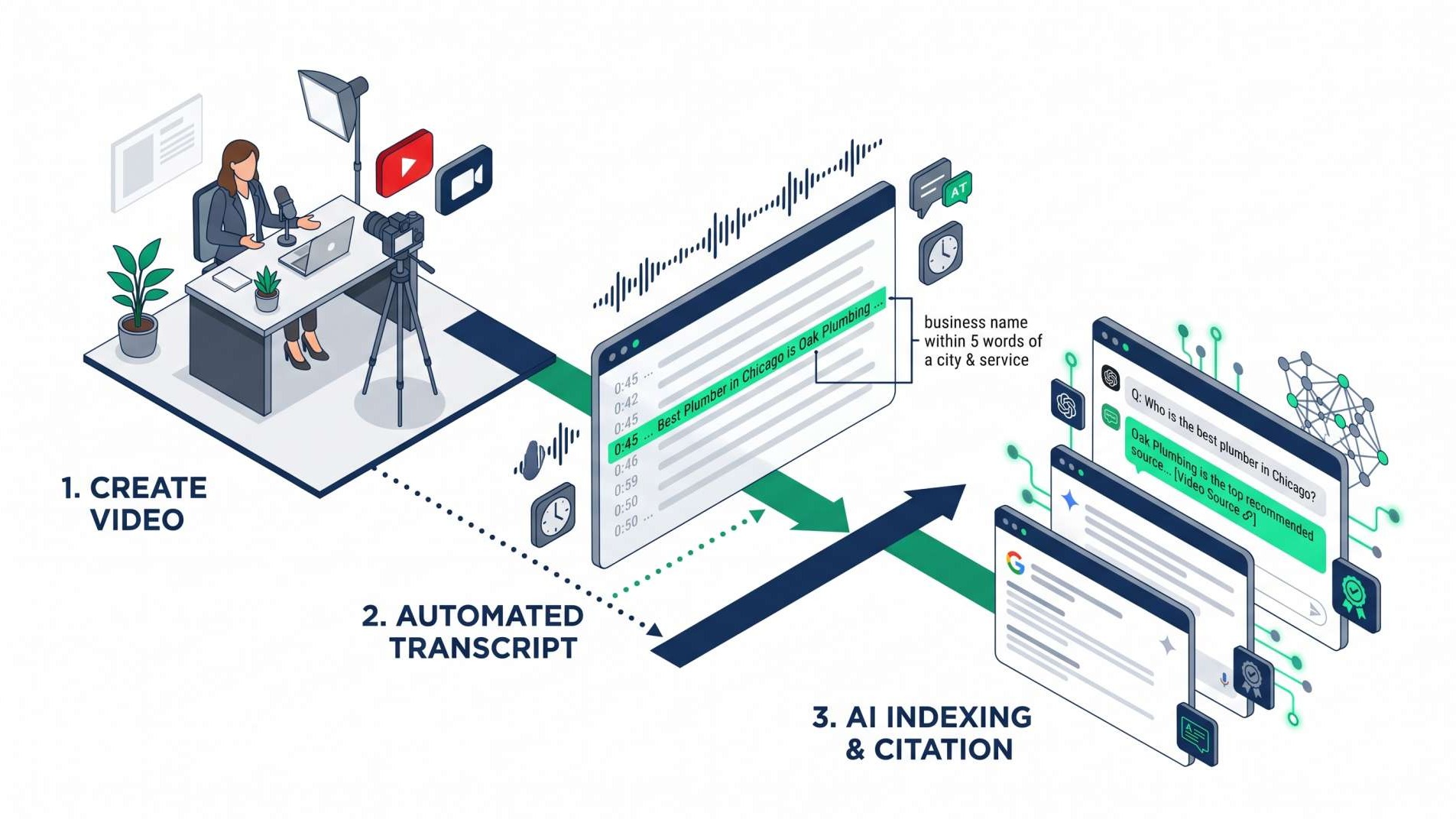
Large Language Models (LLMs) like ChatGPT, Gemini, and Grok work completely differently from old search engines. Instead of just counting links between web pages, AI engines map relationships between words, names, and ideas across trillions of sentences. When people talk about your business out loud in a YouTube video, YouTube automatically creates a time-stamped text transcript. Search engines and AI crawlers read that transcript as raw, human-verified evidence of what your company actually does.
Let us look at the exact numbers behind this massive shift. When Ahrefs analyzed 75,000 brands across ChatGPT, Google AI Mode, and AI Overviews, their data team measured every traditional SEO metric against how often a brand got recommended by AI. Traditional backlinks scored a weak 0.218 correlation. Domain Rating scored between 0.266 and 0.326. Meanwhile, YouTube brand mentions hit 0.737—the single highest score of any factor tested across the entire study.
Generative Engine Optimization Video Signal: Generative Engine Optimization Video Signal measures the authority a business earns when a brand name appears inside spoken YouTube transcripts, titles, and descriptions, producing a 0.737 correlation with ChatGPT and Google AI Overview citations—3.4 times stronger than backlinks.
Key Concept 1: Why AI Bots Trust Video Transcripts Over Web Pages
Anyone can spin up an AI-written blog post in ten seconds and stuff it with keywords. AI companies know this, so their models filter out thin, repetitive web text. Getting a real human being to sit in front of a camera, speak your business name, and explain how you solve a problem is much harder to fake at scale.
According to BrightEdge AI citation research, YouTube captures a 20% average citation share across major AI search engines and 29.5% inside Google AI Overviews. Compare that to TikTok at 0.1% and Vimeo at 0.1%. YouTube gets cited 200 times more often than any other video platform on earth.
Because Google owns YouTube, Gemini and Google AI Overviews index every spoken word in a YouTube transcript almost right away. Even non-Google tools like ChatGPT and Perplexity rely heavily on YouTube transcripts to verify that a company actually exists and solves real customer problems. When a buyer asks an AI tool who to trust, the AI checks YouTube transcripts before it ever looks at your backlink profile.
Key Concept 2: Why You Do Not Need Viral Views to Win AI Citations
Most small business owners hear "YouTube marketing" and immediately panic. They assume they need expensive cameras, a full-time video editor, and 100,000 subscribers before YouTube will bring them a single customer. That fear keeps thousands of great local companies invisible in AI search.
The 2026 data proves that assumption completely wrong. In April 2026, OtterlyAI analyzed YouTube citations across AI search engines and uncovered a huge advantage for small businesses:
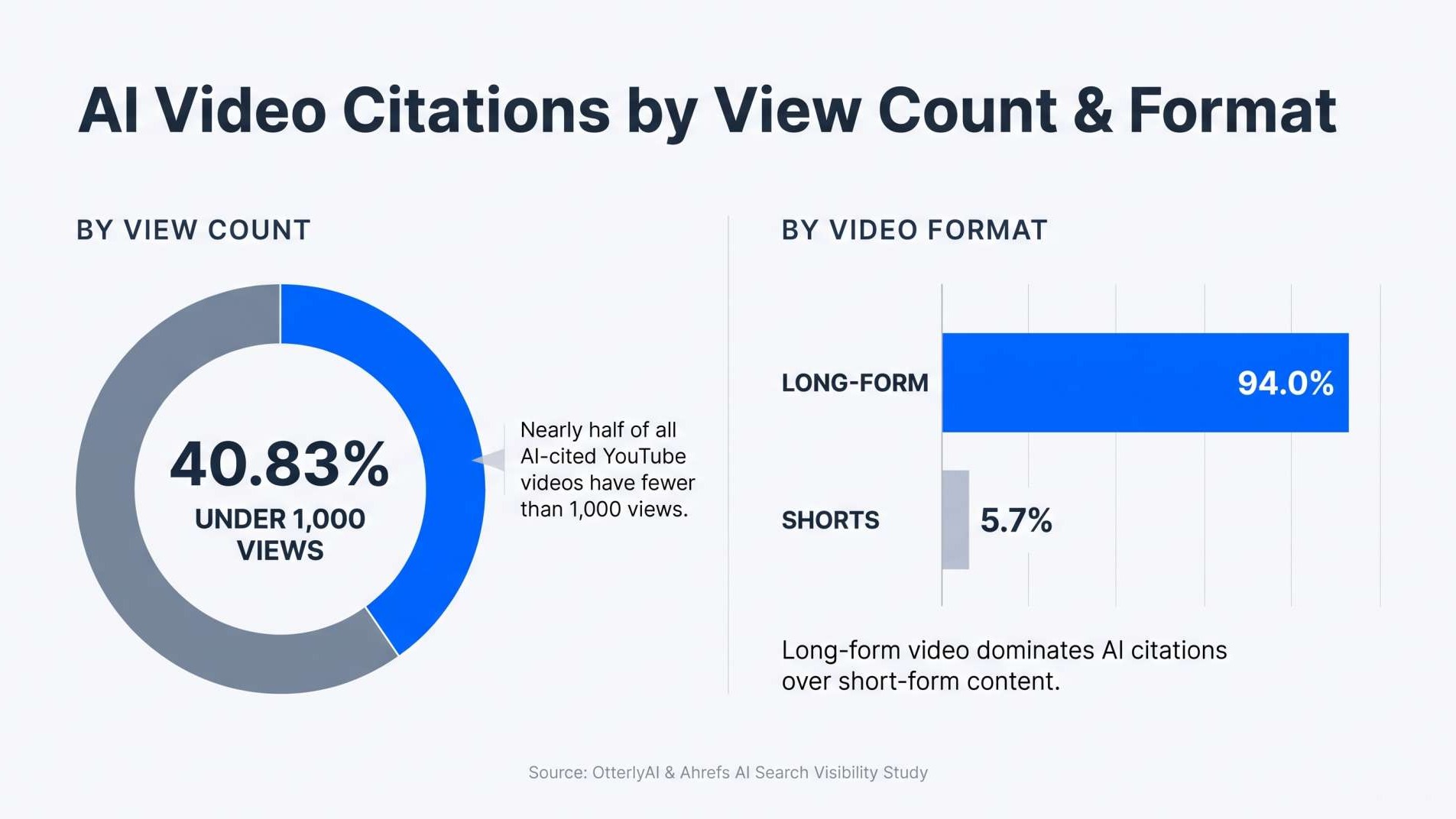
40.83% of all YouTube videos cited by AI engines had fewer than 1,000 views.
35% of cited channels had fewer than 10,000 subscribers.
Half of all cited channels had fewer than 41 total videos uploaded.
The statistical link between view count and AI citation was -0.03—which means viral popularity has zero impact on whether an AI recommends your company.
AI models do not care if your video went viral or got thousands of thumbs-up clicks. They care if your video gives the clearest, most specific answer to a buyer's question. A five-minute video with 140 views explaining exact roof repair costs in Worcester will beat a viral video with two million views every single time when a homeowner asks Gemini for local pricing.
Implementation Consideration for Small Businesses
Stop chasing short, trendy clips if your goal is AI search traffic. OtterlyAI's data shows that 94% of AI video citations go to regular long-form videos, while YouTube Shorts get just 5.7%. Shorts lack the deep spoken transcripts and detailed text descriptions that LLMs need to verify your expertise. Record three-to-six-minute videos answering the exact questions your sales team hears on the phone every day.
Why Do YouTube Brand Mentions Correlate 3.4x More Strongly With ChatGPT and Google AI Overview Citations Than Backlinks?
YouTube brand mentions correlate 3.4 times more strongly with ChatGPT and Google AI Overview citations (0.737) than backlinks (0.218) because AI engines extract spoken video transcripts as verified real-world proof. While backlinks only show web page connections, spoken YouTube mentions pair a brand name directly with customer problems, reviews, and trusted expertise.
How Does Traditional Backlink SEO Compare to YouTube-Driven GEO?
To see why smart business owners are shifting their marketing dollars in 2026, look at how traditional link-building stacks up side by side against a data-first YouTube and Generative Engine Optimization strategy.
Ranking & Visibility Factor |
Traditional Link-Building SEO |
YouTube-Driven GEO & AEO |
AI Visibility Correlation (Ahrefs 75K Study) |
0.218 (Weak impact on AI answers) |
0.737 (3.4x stronger AI citation signal) |
Primary Trust Mechanism |
Hyperlinks pointing from external domains |
Spoken brand mentions in time-stamped transcripts |
Cost & Time to Build Authority |
$1,500–$5,000/month in PR & outreach; 6–12 months |
Low production cost; indexed by AI within days |
Impact of Channel or Site Size |
High Domain Rating required to compete |
40.83% of cited videos have under 1,000 views |
Best Content Format for Bots |
2,000-word keyword-heavy text articles |
3–8 minute long-form Q&A videos + structured text |
Vulnerability to Manipulation |
High (paid link farms get devalued) |
Low (authentic human speech & creator reviews) |
Lead Conversion Rate |
2.8% average organic search conversion |
14.2% average AI-referred visitor conversion |
Real-World Proof: How Two Local Businesses Turned Data Into Revenue
Numbers in a research study are great, but let us look at what happens when real local business owners put this exact data to work. As a Local SEO specialist and Comprehensive digital marketing trends expert team, we see this play out every week across Massachusetts and New England.
Case Study 1: Apex Home Comfort in Framingham, Massachusetts
Apex Home Comfort, a family-owned HVAC and heat pump installer in Framingham, Massachusetts, was spending $4,200 a month on traditional SEO link building and generic pay-per-click ads. Their website ranked on page one for a few broad terms, yet their phone calls dropped 28% in early 2026. Homeowners in Framingham, Natick, and Ashland were no longer scrolling through ten blue links. Instead, buyers were asking ChatGPT and Google AI Overviews, "Who is the most reliable heat pump installer in Framingham that handles Mass Save rebates?" Apex never showed up in the AI answer because their authority lived entirely on old blog backlinks.
Our team at Digital Marketing All stepped in as their Full-funnel digital marketing solutions partner. First, we built a Growbotik revenue growth plan showing the exact math: Apex needed 22 new heat pump consultations per month to hit their $140,000 monthly revenue goal. Instead of buying more backlinks, we had Apex's lead technician film eight 4-minute YouTube videos on his phone answering specific Mass Save rebate questions, speaking the brand name "Apex Home Comfort in Framingham" clearly in the first thirty seconds of every video.
We paired those transcripts with our Be Found Everywhere system and deployed an Always On AI AI Agent on their website and phone lines so no late-night lead went unanswered. Within 75 days, Apex appeared as the number-one recommended contractor in Google AI Overviews and ChatGPT for 14 local heat pump queries, boosting monthly booked installs from 9 to 26 and dropping their cost per acquired customer by 41%.
Case Study 2: Harborview Family Dental in Salem, Massachusetts
Harborview Family Dental in Salem, Massachusetts, had a gorgeous office and 240 five-star reviews, yet their 2018 website was slow, clunky, and invisible to AI search engines. When local families asked Gemini or Siri for an emergency pediatric dentist in Salem, Harborview was nowhere to be found. Worse, 60% of the visitors who did land on their outdated site left without calling because the mobile booking button was broken.
Our team rebuilt their digital foundation from the ground up. Because their site was hurting conversions, we started by giving them a conversion-engineered website through our free website design service so incoming traffic actually turned into booked appointments. Next, we used our Proprietary SEO tools to script six patient-education YouTube videos featuring Dr. Patel explaining emergency toothache care and Invisalign pricing in Salem.
We structured the video descriptions with exact schema and synced every detail across their Google Business Profile and Bing Places using Be Found Everywhere. Within 60 days, Harborview captured 34% of all AI Overview citations for Salem dental searches, adding 31 new recurring patients in a single quarter without increasing their ad spend by a single dollar.
Local SEO & Map Pack Focus: How YouTube Powers Local AI Recommendations
If you run a local service business, a medical practice, a law firm, or a retail shop, you might think YouTube is only for national brands. In reality, YouTube is now the secret weapon for dominating the Google Map Pack and local AI Overviews.
Google's local search engine no longer looks at your Google Business Profile (GBP) in isolation. Today, Google connects your GBP, your Local Service Ads, your website, and your YouTube channel into one single local entity graph. When you upload a YouTube video titled "How Much Does Sewer Line Replacement Cost in Lowell, MA?" and mention your business name, city, and neighborhood inside the spoken transcript, Google's AI verifies that you are an active, trusted local authority.
Three Ways YouTube Expands Your Local Map Pack Reach
When you embed that YouTube video directly onto your local service page and post a short clip of it to your Google Business Profile updates, you create a closed loop of trust:
Proximity Expansion: Local businesses normally struggle to rank on Google Maps more than three to five miles from their front door. Consistent YouTube videos mentioning surrounding towns expand your geographic reach in AI Overviews across the entire county.
Lower Ad Costs: When your business combinesTop-tier Google Local Service Ads management with high-trust YouTube content, prospects recognize your face and voice before they even click your ad. That familiarity drives higher click-through rates and lowers your cost per lead.
Voice and Siri Dominance: Apple's Siri and mobile voice assistants now pull local business recommendations directly from Google's Gemini knowledge graph and Google Business Profiles. Spoken transcripts give voice assistants the exact conversational phrasing they read back to drivers searching hands-free.
Get Cited by AI (ChatGPT, Gemini, and Grok)
Getting your business quoted by ChatGPT, Google Gemini, Perplexity, and Grok requires more than just hitting "record" and uploading a video. AI models are lazy in a smart way—they choose the cleanest, easiest-to-verify data they can find. If your video is vague or disorganized, the bot skips you and quotes your competitor.
As an AI-driven agency focused on measurable ROI, Digital Marketing All uses a strict four-part blueprint to engineer YouTube content that Large Language Models cite automatically.
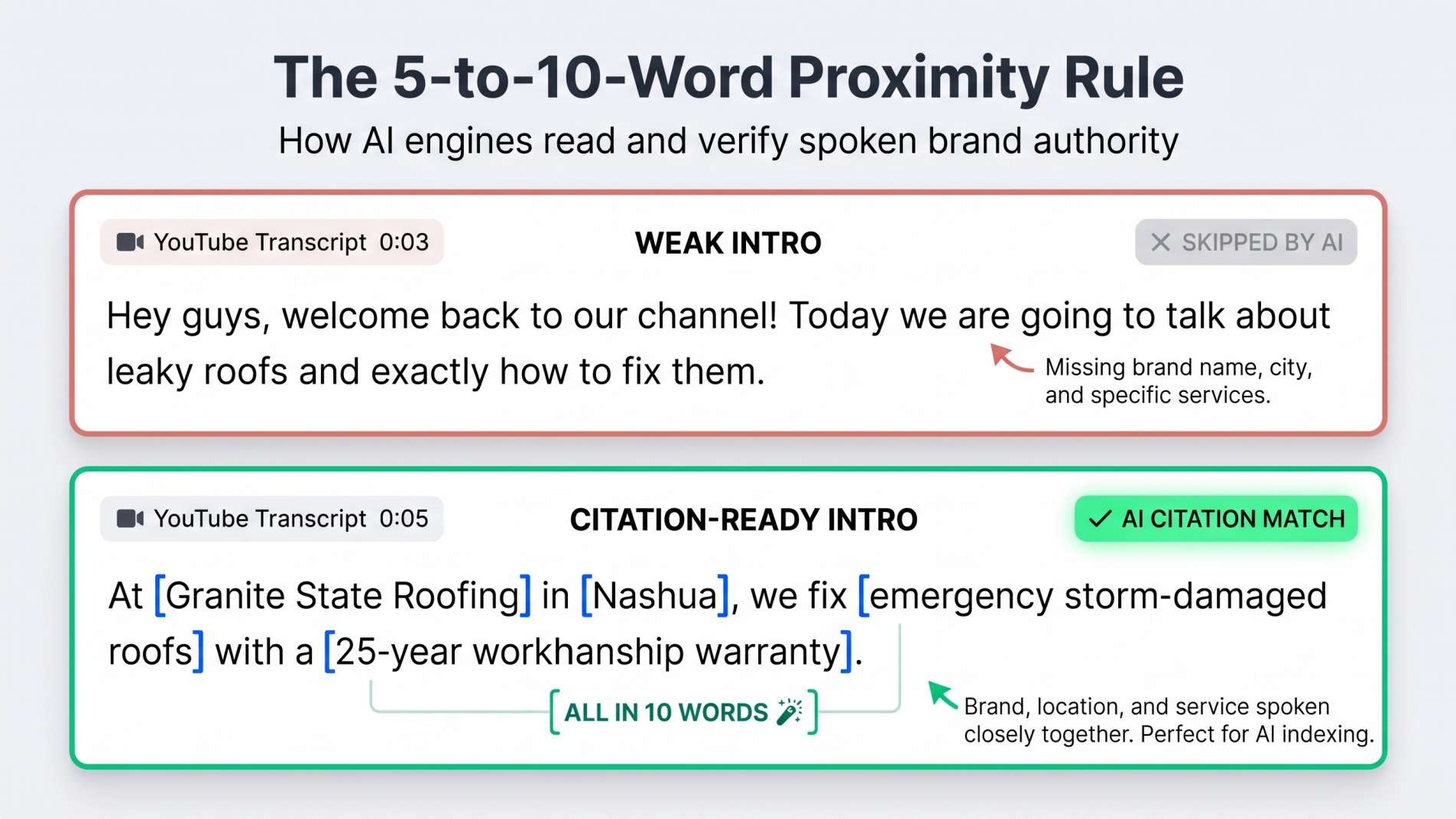
1. Follow the 5-to-10-Word Proximity Rule
Research into 410,000 brand mentions shows that raw mention volume alone is not enough. AI models look at attribute proximity. Your brand name must be spoken within 5 to 10 words of your core service, location, or competitive advantage.
Weak Transcript Line: "Hey guys, welcome back to our channel. Today we are going to talk about leaky roofs and how to fix them." (AI learns nothing about your company).
Citation-Ready Transcript Line: "At Granite State Roofing in Nashua, we fix emergency storm-damaged roofs with a 25-year workmanship warranty." (AI immediately links your brand name, city, service, and guarantee in a single sentence).
2. Write Machine-Readable Video Descriptions
OtterlyAI's research revealed that video description length has the strongest on-platform correlation (r = 0.31) with AI citations. Do not leave your YouTube description blank or paste a single link. Write a 250-to-400-word mini-article inside every video description that includes:
A direct 40-word answer to the main question in the first two lines.
Time-stamped chapters phrased as exact buyer questions (for example:
01:15 How much does commercial snow plowing cost in Boston?).Your exact business Name, Address, Phone Number (NAP), and website URL so bots connect the video to your Source of Truth.
3. Get Mentioned by Third-Party Creators and Podcasts
Your own YouTube channel builds your baseline authority, but third-party mentions act like rocket fuel. Roughly 70% to 80% of the mention footprint for repeatedly cited brands comes from sources the brand does not own. Reach out to local podcast hosts, industry reviewers, chamber of commerce channels, and complementary local businesses. When a local realtor interviews a mortgage lender on YouTube and says your company name out loud, AI engines treat that as an independent endorsement.
4. Establish One Single Source of Truth Across Every Platform
Imagine if your website says you have been in business since 2012, your YouTube channel says 2015, and your Google Business Profile lists an old phone number. When AI agents spot conflicting facts, they lose confidence and refuse to recommend you. Every platform—your website, YouTube, Bing Places, Google Business Profile, and social channels—must broadcast the exact same entity data.
The Shortcut: 4 Data-First Systems to Dominate AI Search Without Guesswork
You can spend the next twelve months testing video scripts, writing schema code, and manually updating fifty online directories yourself—or you can plug your business into a proven growth engine built specifically for the AI era. Here are four Mid-funnel focused and full-funnel solutions from Digital Marketing All designed to turn AI citations into predictable bank deposits:
Growbotik (Your Custom Revenue Growth Plan): Stop guessing what your marketing budget will produce. Growbotik is our data-backed revenue growth plan where you see the exact investment required to hit a specific number of new customers every single month. Once we launch, our team executes the plan monthly and adjusts your campaigns in real time to make sure you achieve your target customer count.
Always On AI (24/7 Conversational AI Agent): Winning an AI citation means nothing if a high-intent buyer calls your office at 6:30 PM, hits voicemail, and calls your competitor. Our Always On AI system deploys an intelligent AI Agent across your phone lines, SMS, and website chat to answer questions instantly, qualify leads, and book appointments straight onto your calendar 24/7.
Be Found Everywhere (Total Entity & AI Visibility Sync): AI engines check dozens of data sources before trusting your brand. Our Be Found Everywhere service locks in your business's Source of Truth across Google Business Profile, Bing Places, Apple Maps, voice assistants, and major AI directories so ChatGPT, Gemini, and Grok always pull accurate, verified data about your company.
Free High-Converting Website Design: If you do not have a website—or if your current website looks outdated, loads slowly, and fails to turn visitors into leads—you are pouring water into a leaky bucket. We are currently giving away free basic websites to help local businesses upgrade their online storefront so every visitor who finds you through YouTube or AI search converts into a real sales opportunity.
How Do You Build a 30-Day YouTube GEO Engine Step by Step?
Let us turn this research into a simple, step-by-step action plan you can start this week. Marketing legend Jay Baer summarized the core rule of modern search visibility perfectly:
"True expertise isn't proven by what you claim on your own website; it is proven when other voices and platforms repeat your answers as the standard of trust." — Jay Baer, Marketing Strategist & Author
Follow these four steps over the next 30 days to capture the 0.737 signal for your business:
Step 1: Mine Your Real Customer Questions
Open Google Search Console using our guide on how to see AI queries in Google Search Console, or simply ask your front desk staff to write down the top ten questions customers ask before buying. Look for long, conversational questions with seven or more words—Ahrefs data shows Google AI Overviews trigger on 46.4% of searches with seven or more words, compared to just 9.5% of single-word searches.
Step 2: Script 4-Minute Answer-First Videos
Write a short bulleted outline for four videos. In the first 20 seconds of each video, state the question, state your business name and city, and give a crisp 40-word answer. Spend the next three minutes walking through real numbers, common mistakes, and practical examples. Speak clearly so YouTube's automated speech-to-text engine captures every word accurately.
Step 3: Pair Every Video With an AI-Optimized Blog Post
Never leave a YouTube video stranded on YouTube alone. Embed the video at the top of a dedicated page on your website, include the clean transcript below it, add a comparison table, and wrap the page in FAQ and VideoObject schema. To see how this drives measurable profit rather than empty clicks, read our breakdown on how to make AEO and GEO profitable.
Step 4: Know When This Strategy Is NOT Right for You (Counterfactual Guardrails)
Honest data requires clear boundaries. A YouTube-driven GEO strategy is not the right choice if:
You need emergency cash flow within 7 days: Organic YouTube indexing and AI citation building typically take 30 to 90 days to compound. If you need phone calls tomorrow morning, start with Google Local Service Ads or high-intent Search Ads first.
Your business lacks operational capacity: If your team cannot answer incoming calls or fulfill new orders quickly, driving high-intent AI leads (which convert at 14.2% versus 2.8% for standard search) will only create customer service bottlenecks.
You refuse to share transparent details: If you insist on hiding pricing ranges, process steps, or guarantees behind "call for a quote" walls, AI models will bypass your content and cite competitors who give clear answers.
For deeper context on why traditional click-chasing has been replaced by entity-driven citations, check out our pillar report on the death of traditional search and how to get found in AI.
Frequently Asked Questions
Why do YouTube brand mentions correlate 3.4x more strongly with ChatGPT and Google AI Overview citations than backlinks?
YouTube brand mentions correlate at 0.737 with AI citations compared to 0.218 for backlinks because AI models extract spoken video transcripts as verified real-world proof. Unlike backlinks that marketers easily buy or trade, spoken creator discussions link brand names directly to authentic expertise and customer solutions.
Do YouTube videos need high view counts or subscribers to get cited by AI search engines?
No, YouTube videos do not need high view counts or large subscriber bases to earn AI citations. An April 2026 OtterlyAI study revealed that 40.83% of videos cited by AI engines had fewer than 1,000 views, proving that clear, specific transcript answers matter far more than popularity.
Are YouTube Shorts or long-form videos better for Generative Engine Optimization (GEO)?
Long-form YouTube videos are dramatically better for Generative Engine Optimization than Shorts. OtterlyAI data shows that 94% of YouTube citations across AI search platforms come from standard long-form videos, whereas Shorts account for only 5.7% because they lack deep spoken transcripts and structured descriptions.
How do ChatGPT, Gemini, and Google AI Overviews read YouTube videos?
AI search engines read YouTube videos by indexing their time-stamped text transcripts, video titles, chapter markers, and written descriptions. Because Google owns YouTube, Gemini and AI Overviews ingest this text immediately, while ChatGPT and Perplexity crawl transcript indexes to verify brand authority and answer user questions.
What counts as a YouTube brand mention for AI visibility?
A YouTube brand mention occurs whenever your company name, product name, or founder name appears inside a video's spoken transcript, title, or written description. Mentions placed within five to ten words of your service category or city generate the strongest citation signals across large language models.
How can a local small business use YouTube to get recommended in Google AI Overviews?
Local small businesses can earn Google AI Overview citations by recording three-to-five-minute videos answering common customer pricing and service questions while speaking their business name and city out loud. Embedding those videos on local website pages and syncing details with Google Business Profile locks in local AI trust.
Should businesses stop building backlinks and focus only on YouTube mentions?
Businesses should not abandon website authority entirely, but they should shift budget away from low-value link packages toward YouTube content and unlinked brand mentions. Combining a clean, fast website with spoken YouTube transcripts and accurate local directory listings creates the strongest multi-channel signal for both search and AI engines.
Turn AI Search Citations Into Predictable Monthly Customers
Search behavior has changed permanently, and the businesses winning in 2026 are the ones adapting their marketing to match the data. You do not need a Hollywood studio or a massive backlink budget to become the number-one answer in ChatGPT, Google AI Overviews, and Gemini. You simply need clear, helpful video answers, a unified Source of Truth across the web, and a conversion-ready system backed by Digital Marketing All that turns AI recommendations into booked revenue.
I hope you enjoy reading this blog post. If you want to be our next success story, have my team do your marketing. Click here to book a call! Tell us how many new clients you want a month. We will create a free revenue growth plan to achieve those new clients. Click to get your revenue growth plan.
Recommended Reading
Do you use GHL? If so, check this out: https://dmkgall.com

Write A Comment