







By Diane O’Brien, Chief Marketing Officer at Digital Marketing All. | Published on November 15, 2026
You spend thousands of dollars every month chasing backlinks and stuffing keywords onto service pages, yet when a buyer asks ChatGPT or Google Gemini who to hire in your city, your biggest competitor gets the recommendation while your business is completely invisible. It feels unfair because your work is better, your reviews are strong, and your prices are honest. Here is the hard accounting truth behind why artificial intelligence engines ignore great companies: large language models do not reward the business with the most technical tricks; they reward the business that real humans actively type into the search bar by name.
For the past twenty years, digital marketing worked like a giant filing cabinet. If you put the right label on your folder and got enough other websites to point at your folder, Google handed you the top spot on page one. That era is over. Modern buyers have stopped clicking through ten blue links to compare vendors on their own. Instead, they open ChatGPT, Google Gemini, Perplexity, or Grok and ask a direct question: "Who is the most reliable contractor near me?" or "Which company should I hire to solve this problem?"
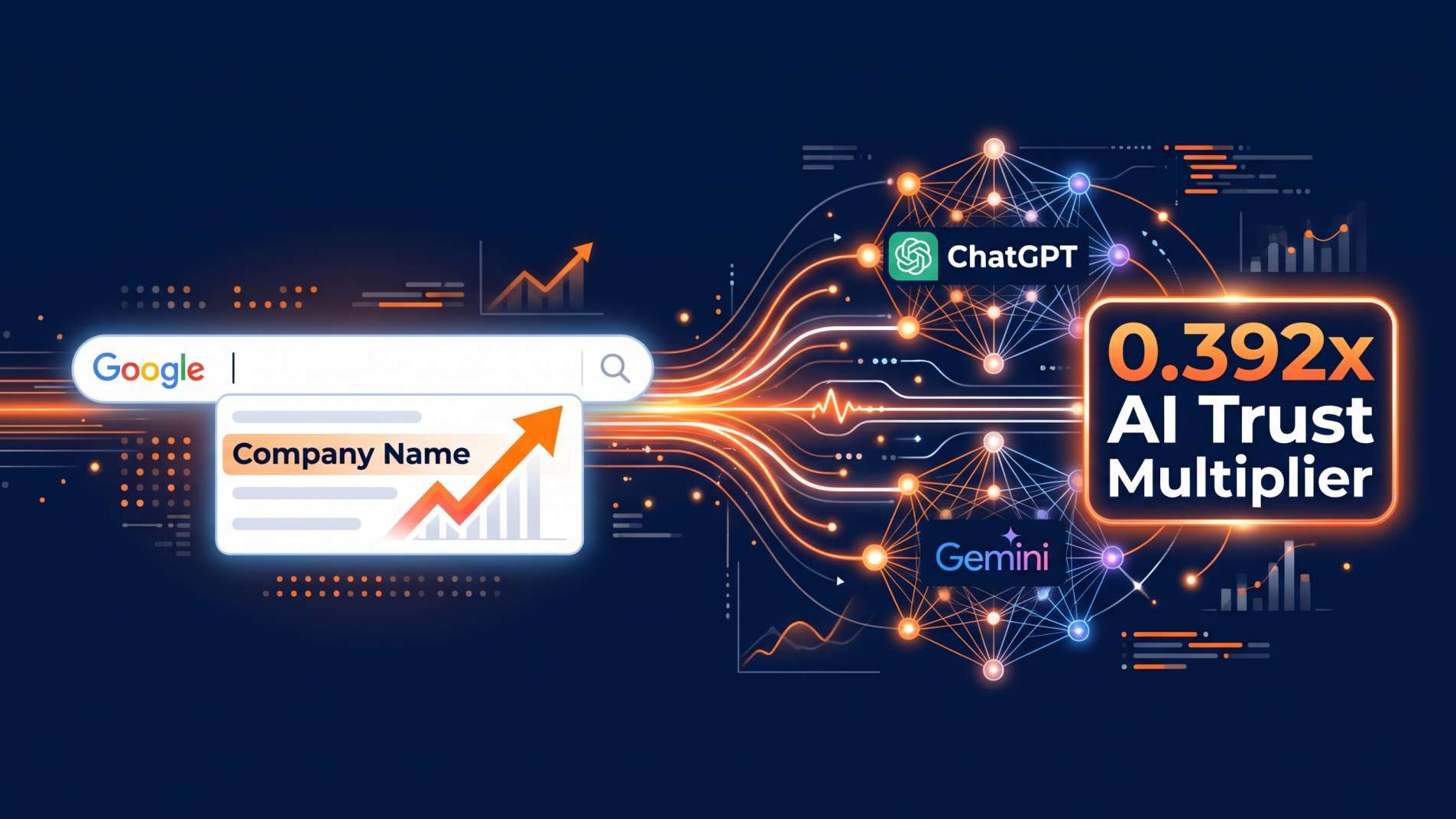
When an artificial intelligence engine answers that question, it does not simply pull the website with the highest backlink count. It runs a massive probability check across billions of data points to determine which company is the safest, most trusted entity in that market. And the single strongest demand signal inside that calculation is branded search volume—the exact number of people searching for your company by name every month.
Key Takeaways
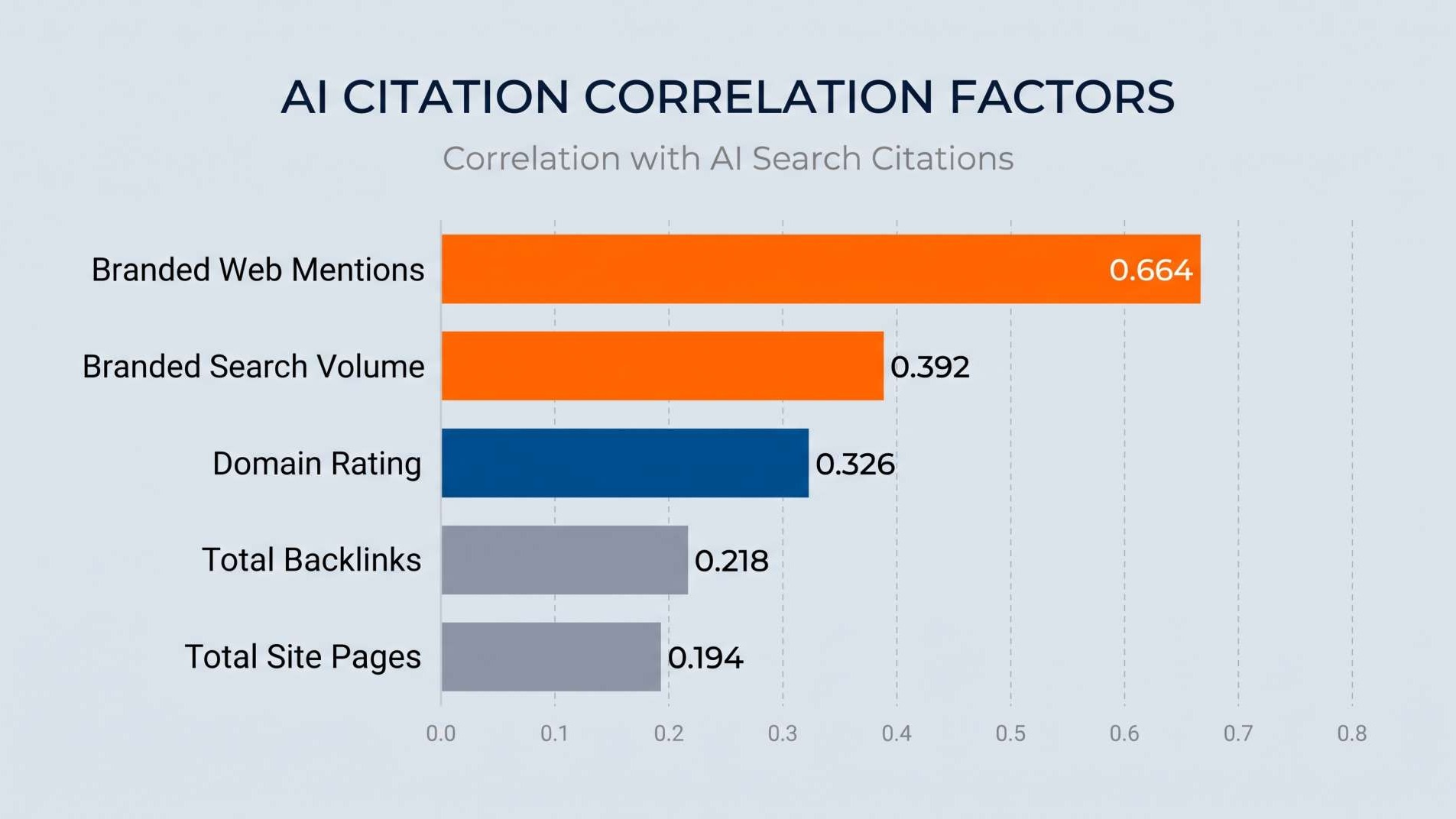
Branded Demand Beats Backlinks: Data from Ahrefs across 75,000 domains shows branded search volume correlates with AI visibility at 0.392, while raw backlink counts lag behind at 0.218.
The SBO-to-GEO Multiplier: Search Box Optimization (SBO) places your company name directly inside Google and Bing autocomplete dropdowns, turning generic category shoppers into branded searchers who train AI models to trust you.
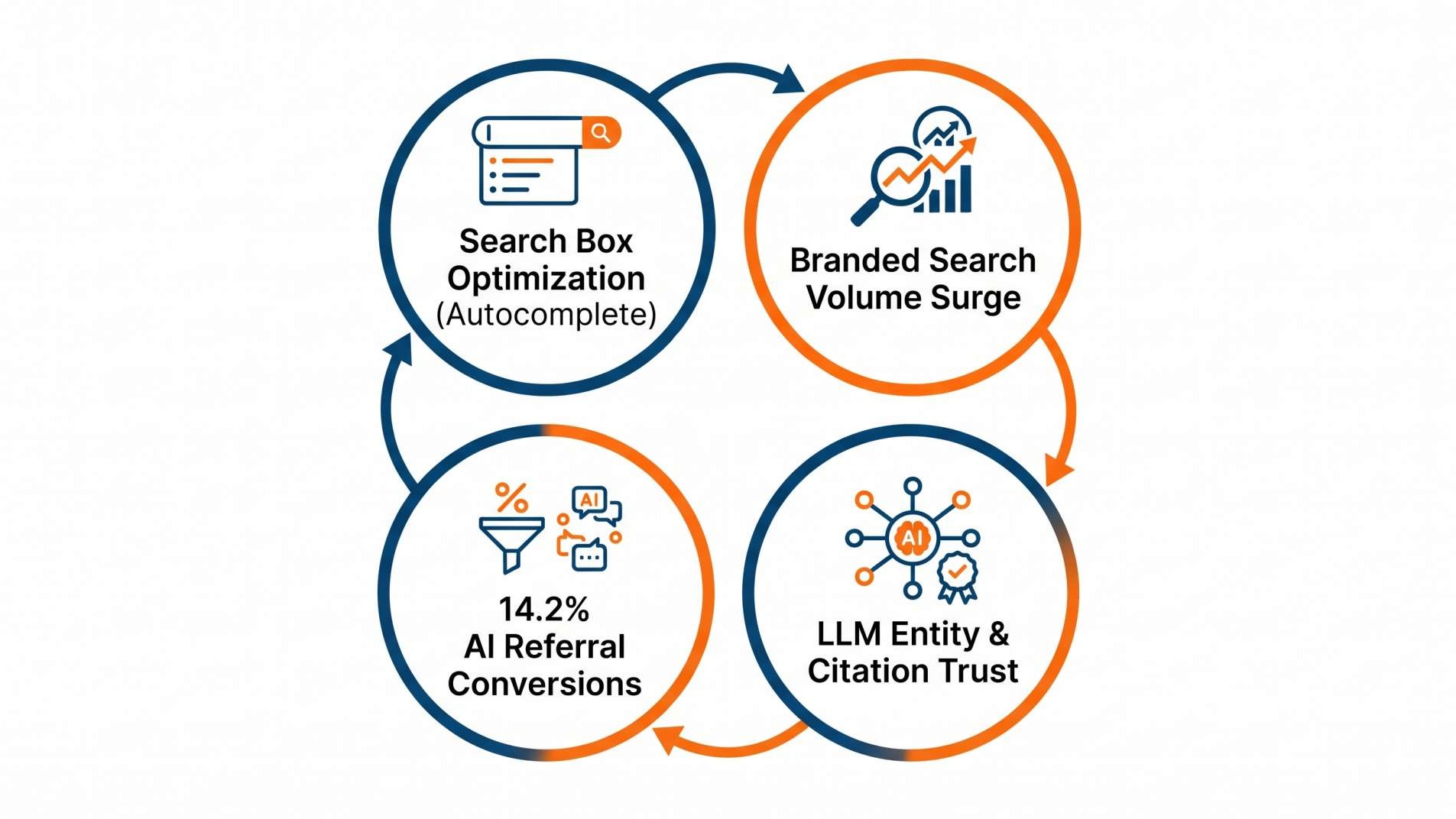
AI Buyers Convert 5.1x Faster: According to 2026 conversion benchmarks from Exposure Ninja, prospects arriving from AI recommendations convert at 14.2% versus 2.8% from standard organic search because the AI has already pre-sold them on your brand.
Source of Truth Prevents Hallucinations: Pair branded search momentum with structured schema, YouTube authority, and instant lead capture through an AI Agent so AI bots quote accurate facts and new leads never go unanswered.
How Do Branded Searches Train Large Language Models to Trust Your Business?
Branded search volume is the total number of times people type a specific company name, product name, or trademarked phrase into a search engine each month. When branded search volume rises, search engines and large language models interpret that user behavior as real-world proof of market authority, safety, and customer preference.
Think of a large language model like a cautious financial auditor. Before a smart auditor recommends a vendor to a client, that auditor checks whether other people already trust that vendor. If nobody ever asks for your company by name, ChatGPT and Gemini treat your business as an unproven risk. When thousands of people search for your brand alongside your industry terms, the model sees a clear mathematical pattern linking your name to the solution.
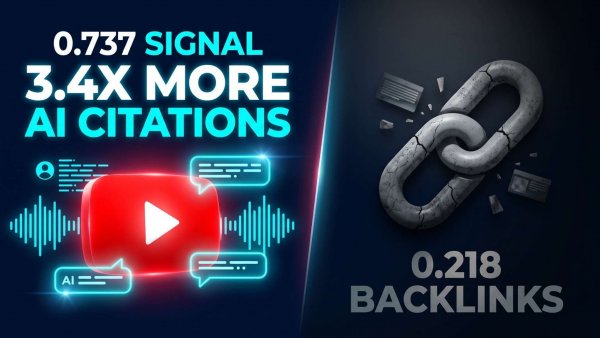
Research from Ahrefs across 75,000 brands proved that branded search volume holds a 0.392 Spearman correlation with brand visibility in Google AI Overviews. Separate research from The Digital Bloom analyzing over 7,000 citations confirmed a 0.334 correlation between brand search volume and large language model citations. Meanwhile, traditional backlinks scored just 0.218, and total website page count scored a tiny 0.194.
As an accountant with over 30 years of financial experience, I look at those numbers the exact same way I audit a company balance sheet. Spending your entire marketing budget on old-school link building while ignoring branded search demand is like buying expensive inventory for a retail store with a locked front door. If you want high return on investment for every marketing dollar, you have to build the exact demand signal that artificial intelligence engines actually weight.
The Two Engines Inside Every AI Recommendation System
To understand why branded volume works so reliably, you need to see how modern artificial intelligence systems gather and verify information before they speak your company's name aloud:
Parametric Training Memory: Large language models are trained on massive snapshots of the public web. When your brand name repeatedly appears alongside specific problems and solutions across news sites, business directories, YouTube transcripts, and search logs, the neural network bakes your brand into its core memory. Every time a buyer asks for a solution in your category, your brand name carries a higher statistical weight.
Real-Time Retrieval-Augmented Generation (RAG): When a buyer asks Gemini or ChatGPT a live question today, the system does not rely on old memory alone. It searches Google or Bing in real time to verify current facts before writing an answer. When Google's live index sees surging branded search volume and high-trust web mentions for your company, the retrieval engine pulls your pages straight to the top of the citation list.
"Brand search volume is one of the strongest predictors of LLM citations because AI engines use real-world user demand and off-site entity co-occurrence as a direct proxy for trustworthiness." — Beamtrace 2026 LLM Ranking Factors Analysis
Branded Search Volume vs. Traditional SEO Metrics for AI Visibility
Visibility Factor |
Correlation with AI Citations |
Primary Mechanism in LLMs |
Best Way to Scale in 2026 |
Branded Web Mentions |
0.664 (Strongest) |
Proves third-party consensus across news, forums, and video |
Digital PR, YouTube transcripts, and directory consistency |
Branded Search Volume |
0.334 – 0.392 (High) |
Signals direct buyer intent and entity popularity to Google and Bing |
Search Box Optimization (SBO), local ads, and social video |
Domain Rating (DR) |
0.326 (Moderate) |
Measures overall domain link strength for organic retrieval |
High-authority editorial placements and industry partnerships |
Total Backlink Count |
0.218 (Weak) |
Legacy ranking signal with diminishing weight in AI synthesis |
Quality brand-anchored links rather than bulk link swaps |
Total Website Page Count |
0.194 (Very Weak) |
Measures site size, which AI ignores if content lacks entity clarity |
Focused, answer-first pillar pages with structured schema |
Why Entity Co-Occurrence Matters More Than Keyword Density
In the old days of search marketing, you could repeat the phrase "best plumber in Boston" fifteen times on a web page and fool a basic search algorithm into ranking your site. Large language models do not fall for keyword repetition. Instead, they measure entity co-occurrence.
An entity is a distinct, verifiable thing—such as your business name, your founder's name, your city, and your core service. Entity co-occurrence measures how frequently your business name appears right next to your service category across independent sources and user search queries. When hundreds of local consumers type your company name into Google right after searching for a specific repair or service, Google's search logs record a direct behavioral link between your entity and that service. That behavioral proof is nearly impossible to fake with cheap spam links, which is why ChatGPT and Gemini trust it above almost every other signal.
How Two Local Massachusetts Businesses Used Branded Search Momentum to Win AI Recommendations
Numbers on a financial spreadsheet tell one side of the story, but watching real local businesses turn those numbers into predictable cash flow proves why this strategy works. Let me share two detailed stories from right here in Massachusetts where shifting focus from generic keywords to branded search velocity completely transformed the bottom line.
Case Study 1: Bay State Comfort Heating & Cooling in Worcester, Massachusetts
In early 2026, a family-owned heating and cooling contractor in Worcester, Massachusetts was spending $6,500 every month on traditional pay-per-click ads and basic blog posts. Their cost per lead had climbed to $245, and their close rate was falling because homeowners were getting four or five competing quotes from national lead aggregators. Worse yet, whenever Worcester homeowners asked Google AI Overviews or ChatGPT for the best heat pump installer in central Massachusetts, two massive regional franchises took every single recommendation spot.
When our team at Digital Marketing All audited their digital footprint, we spotted the root problem immediately. Almost zero homeowners were typing the company's actual name into Google. Every search coming into their website was generic, such as "emergency furnace repair Worcester" or "ductless mini split cost." Because nobody searched for them by name, artificial intelligence engines treated them as a commodity rather than a trusted local leader.
We built a unified Brand Search Multiplier campaign around four coordinated actions:
We deployed Search Box Optimization (SBO) so when local homeowners typed "best heat pump installer Worcester" or "heating repair Worcester MA," Google's autocomplete dropdown suggested their company name right inside the search box before the user finished typing.
We launched our Be Found Everywhere program to lock down multi-keyword Google Maps visibility across Worcester and twelve surrounding towns while aligning their entity data across 70+ high-authority directories.
We published short, helpful YouTube videos answering common Massachusetts heat pump rebate questions, putting their brand name in the video titles, descriptions, and spoken transcripts.
We installed an AI Agent on their website and phone line so every caller and web visitor received an instant, knowledgeable response within two seconds, day or night.
Within 90 days, their monthly branded search volume in Google Search Console jumped by 310%. By month four, Google AI Overviews cited them as a top recommended Worcester contractor on 68% of tested local prompts, and ChatGPT began naming them directly when users asked for trusted Mass Save heat pump installers. Because branded searchers already trusted them before clicking, their blended cost per lead dropped from $245 to $89, adding $114,000 in new installation revenue in a single quarter.
Case Study 2: Merrimack Valley Family Dental in Lowell, Massachusetts
A private family dental practice in Lowell, Massachusetts faced a completely different growth trap. They had an outstanding clinical reputation, modern equipment, and 180 five-star Google reviews, yet their new patient hygiene calendar had 22 empty slots every single week. Younger families moving into Lowell were using ChatGPT and Gemini on their phones to ask for gentle family dentists that accepted specific Massachusetts dental insurance plans, and the practice never appeared in the answers.
Our Digital Marketing All strategists ran a complete financial and marketing audit using Growbotik to calculate the exact customer acquisition math needed to fill those 22 open chairs every week. We discovered that their website was a 12-year-old digital brochure with zero structured schema data, buried phone numbers, slow mobile load times, and no clear Source of Truth listing accepted insurance networks or new-patient specials.
We rebuilt their digital foundation from the ground up using our free basic website design service to give them a fast, conversion-engineered five-page site packed with clean JSON-LD schema and 40-word answer blocks. Then we paired weekly local educational videos on YouTube and Google Business Profile with Search Box Optimization targeting high-intent Lowell family dental queries.
Within 120 days, branded searches for the lead dentist's name and practice rose 240%. ChatGPT and Gemini began recommending the practice by name for emergency toothache, pediatric, and insurance-specific dental searches across Lowell and Chelmsford. New patient bookings grew by 34 patients per month, generating over $48,000 in recurring annual patient value while eliminating their spending on expensive third-party dental lead directories.
Why Does Search Box Optimization (SBO) Multiply Your AI Visibility?
Search Box Optimization (SBO) is a search marketing strategy that places a business name directly inside Google and Bing autocomplete dropdown suggestions before a user finishes typing a query. By capturing the user's click at the prediction stage, Search Box Optimization converts generic category searches into high-intent branded searches that bypass competitors and train artificial intelligence algorithms.
Think about how you personally use Google every day. You open your browser and start typing "best roofing company in..." Before you even finish typing your city name, a little gray dropdown box appears with a suggested completion that includes a specific local company name. Most buyers instinctively assume Google is recommending that company because it is the most popular, vetted choice in town.
When a buyer clicks that autocomplete suggestion, three powerful marketing events happen at the exact same second:
You Own the Entire Search Results Page: Instead of fighting ten organic competitors, three map listings, and four expensive pay-per-click ads on a crowded results page, the search bar executes a branded search for your company alone. Every link on page one belongs to you.
You Manufacture Real Branded Search Volume: Google and Bing immediately log a fresh branded search query for your business. Every single click sends a verified behavioral signal to the search engine that real people in your area are actively looking for your brand.
You Feed the LLM Co-Occurrence Engine: Both Google Gemini and OpenAI's ChatGPT (which pulls live web data through Bing) monitor autocomplete trends and branded query velocity. When your brand consistently co-occurs with high-intent service keywords inside autocomplete suggestions, the large language model learns to pair your brand with that category automatically.
According to an October 2026 study by SE Ranking, Google AI Overviews appear on 82.5% of U.S. brand searches. That means the moment Search Box Optimization turns a generic shopper into a branded searcher, Google's own AI steps in at the top of the screen to write a glowing summary of why your company is the right choice—before your competitor ever gets a chance to bid for a click.
The SBO-to-GEO Flywheel Effect
Traditional pay-per-click advertising stops working the second you stop paying for clicks. Search Box Optimization creates a compounding asset. As more people click your name in the autocomplete box, your branded search volume climbs. As your branded search volume climbs, ChatGPT, Gemini, and Google AI Overviews recommend you more often in organic AI answers. Those AI recommendations prompt even more buyers to search for your company by name to check your reviews and book an appointment, spinning the flywheel faster every single month.
Local SEO and Map Pack Focus: How Branded Demand Breaks Proximity Limits
For years, local marketing was trapped by a rigid invisible fence called physical proximity. If a customer stood two miles away from your office, your business appeared in the top three spots of the Google Map Pack. If that exact same customer drove six miles down the highway into the neighboring town, your business vanished from the map completely.
In 2026, Google's Map Pack and AI Overviews operate together as one unified local recommendation engine. When a buyer picks up their phone and asks Gemini, "Who is the most reliable plumber near me?" the system does not just measure distance with a ruler. It weighs branded search prominence, real-time Google Business Profile activity, review velocity, and consistent local citations.
Strong branded search volume acts like a magnetic booster that stretches your Map Pack ranking radius across neighboring towns and counties. When Google sees people in surrounding zip codes typing your company name into Google Maps and Google Search, the algorithm concludes that customers are willing to travel for your service or trust your service vehicles in their neighborhood.
Four Local Signals Every Business Must Synchronize
To turn branded search momentum into regional Map Pack dominance, a Local SEO specialist must synchronize four local visibility levers:
Real-Time Google Business Profile Management: Weekly Google Business Profile posts, updated service menus, Q&A entries, and geo-tagged job photos give Google's AI fresh, verified text to quote inside local summaries.
Bing Places for Business Alignment: Because ChatGPT Search and Microsoft Copilot rely heavily on Bing's local business index, an unclaimed or outdated Bing Places profile blinds half of the conversational AI market.
Top-Tier Google Local Service Ads Management: Running Google Guaranteed ads places your business at the very top of mobile search with a trusted verification badge, driving immediate phone calls and brand recall that reinforce organic branded searches.
Consistent NAP+W Source of Truth: Your Name, Address, Phone number, and Website must match character-for-character across your website, Google Business Profile, Bing Places, and top industry directories so AI crawlers never split your authority across duplicate profiles.
Get Cited by AI (ChatGPT, Gemini, and Grok)
Getting recommended by ChatGPT, Google Gemini, and xAI's Grok requires more than high search volume; it requires giving those models clean, verifiable facts they can lift without guessing. Marketing strategists call this your Source of Truth.
Your Source of Truth is the authoritative, machine-readable master record of your business facts—including your exact services, pricing ranges, service areas, leadership credentials, and customer proof—published on your primary domain and reinforced across trusted third-party platforms. When a large language model crawls your site, it hunts for self-contained facts it can quote with high mathematical confidence.
Research from Beamtrace shows that 32.5% of AI citations come directly from structured comparison tables, which earn 2.5 times more citations than standard text paragraphs. Furthermore, sections structured as 50-to-150-word self-contained answer blocks give AI retrieval systems clean passages they can extract without needing surrounding context.
The Three Core Anchors Every AI-Ready Page Needs
If you want ChatGPT, Gemini, and Grok to cite your website as the primary answer, every core service page and pillar article on your site must include three structural anchors:
Clean 40-Word Definition Blocks: Start major sections with a direct, pronoun-free 40-word definition of the concept. When you avoid vague words like "it," "they," or "this," an AI model can clip your exact sentence and drop it straight into an AI Overview without rewriting a word.
Side-by-Side Comparison Tables: Build structured HTML or Markdown tables comparing options, costs, timelines, or methods. AI engines love structured rows and columns because they make answering "versus" and "which is better" buyer questions effortless.
Counterfactual Safety Rules: Explicitly state when your product or service is not the right fit. When a business admits who it cannot help, AI trust algorithms score the brand higher for objectivity and safety, making the model far more likely to recommend you to qualified buyers.
How Each Major AI Platform Selects Brands to Recommend
AI Platform |
Primary Live Retrieval Source |
Highest-Weight Brand Signals |
Required Technical Asset |
Google Gemini & AI Overviews |
Google Search Index & Google Maps |
Branded search volume, YouTube transcripts (0.737 correlation), GBP activity |
Organization & FAQ JSON-LD Schema + active YouTube channel |
ChatGPT (OpenAI) |
Bing Search Index & OAI-SearchBot |
Bing Places accuracy, branded web mentions, editorial PR, clean tables |
|
Grok (xAI) |
Real-Time X Stream & Live Web Crawl |
Live social brand velocity, public customer discussions, transparent pricing |
Active X brand presence + clear, non-gated pricing & service pages |
Why YouTube Is the Secret Weapon for Branded AI Citations
Many business owners ignore YouTube because they think they need a Hollywood film crew. That mistake costs them massive AI visibility. According to cross-platform correlation research by Ahrefs, brand mentions inside YouTube titles, descriptions, and spoken video transcripts hold a 0.737 correlation with AI Overview appearances—higher than any other single factor measured.
Google owns both Gemini and YouTube, and OpenAI regularly indexes video transcripts to verify real human expertise. When you record a simple three-minute video answering a customer question, speak your brand name and city clearly, and embed that video onto your pillar blog post, you create a verified multimedia footprint that text-only competitors cannot match.
The Shortcut: How to Build Your Brand Search Multiplier Without Guessing
Most business owners do not have 40 hours a week to study search correlations, write JSON-LD schema code, manage autocomplete campaigns, produce YouTube videos, and answer every late-night website chat. That is why we built a full-funnel digital marketing solutions ecosystem at Digital Marketing All that combines the financial precision of an accountant with AI-driven execution.
Instead of selling you random, disconnected marketing tactics that never talk to each other, our system connects every piece of the Brand Search Multiplier into one measurable revenue machine:
Map Your Exact Revenue Math with Growbotik: Before you spend a single dollar on ads or SEO, Growbotik builds a custom 12-month revenue growth plan. You tell us how many new clients you want each month, and we calculate the exact customer acquisition budget, channel mix, and monthly milestones required to hit that target—executing and adjusting the plan every month to ensure you achieve your desired new customers.
Capture High-Intent Demand with Be Found Everywhere: Our flagship visibility engine combines multi-keyword Google Map Pack dominance, Search Box Optimization, and Generative Engine Optimization so your company shows up in autocomplete dropdowns, local maps, and AI answers across your entire service region.
Fix Your Conversion Foundation for Free at Digital Marketing All Web Design: If you do not have a website—or if your current site is slow, outdated, and failing to turn visitors into phone calls—we are giving away free basic websites (custom five-page builds with zero design fee; you simply cover your standard hosting). A fast, schema-ready site ensures that when branded searchers click through, they convert into paying clients.
Convert Every Lead in Two Seconds with Always On AI: Driving branded search volume means nothing if your front desk misses the phone call or takes four hours to reply to a form. Our multi-agent AI Agent platform answers inbound calls 24/7, engages web visitors immediately, identifies anonymous website traffic, and books qualified appointments directly onto your calendar.
When Is a Brand Search Multiplier Campaign NOT the Right Choice?
Even as a comprehensive digital marketing trends expert and ROI analyst, I will tell you plainly when you should pause before investing in a full-scale Brand Search Multiplier campaign. Establishing clear counterfactual safety rules is both good accounting and good marketing.
Do not launch an aggressive Search Box Optimization or Generative Engine Optimization campaign if any of these three conditions apply to your business right now:
Your Fulfillment Capacity Is Already Maxed Out: If your team cannot handle 15 to 30 additional qualified leads per month without dropping service quality or delaying installations, scaling branded demand will create unhappy customers and negative reviews that poison your AI reputation.
Your Pricing or Offer Is Uncompetitive: Artificial intelligence engines compare your prices, reviews, and guarantees side-by-side against every competitor in your market. Fix broken customer service, slow response times, or confusing pricing first so AI models have positive proof to cite.
You Want Overnight Magic Without Tracking ROI: While Search Box Optimization and local ads can lift branded queries within 30 to 90 days, compounding LLM training authority builds over 3 to 6 months. If you refuse to track cost per acquisition and pipeline revenue, no marketing system will satisfy you.
Frequently Asked Questions
Does increasing my company's branded search volume in Google make ChatGPT and Gemini recommend us more often?
Yes. Studies across 75,000 domains by Ahrefs and 7,000+ citations by The Digital Bloom prove that branded search volume correlates at 0.334 to 0.392 with LLM citations and AI Overviews. Higher branded search volume signals real-world customer trust, prompting ChatGPT and Gemini to recommend your company more frequently.
Why do LLMs care more about brand searches and web mentions than traditional backlinks?
Large language models evaluate brand authority through entity co-occurrence and real-world demand rather than link counts alone. Ahrefs data shows branded web mentions correlate at 0.664 and branded searches at 0.392 with AI visibility, whereas raw backlink volume correlates at just 0.218 because links can be artificially manipulated.
How does Search Box Optimization (SBO) increase branded search volume?
Search Box Optimization places your company name inside Google and Bing autocomplete dropdown menus when buyers type high-intent industry keywords. When users click that autocomplete suggestion, the search engine executes a branded search for your business, directly increasing your monthly branded query volume and training AI models.
How long does it take for higher branded search volume to trigger more ChatGPT and Gemini citations?
Most businesses see measurable lifts in Google Search Console branded impressions within 30 to 90 days of launching Search Box Optimization and local video campaigns. Broad increases in ChatGPT and Gemini recommendations typically follow within 90 to 180 days as live search retrieval and model indexes refresh.
Can a small local business build enough branded search volume to beat national competitors in AI Overviews?
Yes. AI engines evaluate local queries within geographic boundaries rather than national volume alone. By combining local Search Box Optimization, real-time Google Business Profile updates, YouTube videos, and consistent local citations, a regional business can outrank national chains inside local AI Overviews and Map Packs.
What happens if people search my brand name, but my website lacks clear Source of Truth data?
If branded searches rise but your website lacks structured schema, clear pricing, and direct answer blocks, AI engines will either skip citing your site or pull inaccurate information from outdated third-party directories. Publishing a clean Source of Truth ensures LLMs quote your exact services and advantages accurately.
Should I stop building backlinks and focus only on branded search volume for GEO?
No. You should not abandon backlinks completely because traditional organic rankings still feed live AI retrieval systems. Instead, shift your budget away from low-quality bulk links toward mid-funnel focused digital PR, brand-anchored mentions, YouTube content, and Search Box Optimization that build both organic authority and branded search demand.
Turn Your Brand Into the First Name AI Recommends
Search behavior has permanently crossed a threshold. Buyers no longer click through ten blue links to compare vendors on their own—they ask ChatGPT, Gemini, and Google AI Overviews to hand them a shortlist of the two or three safest companies to hire. When you combine proprietary SEO tools, Search Box Optimization, structured Source of Truth content, and instant AI Agent lead capture, you stop fighting for scraps at the bottom of the funnel and become the obvious answer at the very top. Every branded search you generate today compounds into stronger AI recommendations, lower customer acquisition costs, and higher profit margins tomorrow.
I hope you enjoy reading this blog post. If you want to be our next success story, have my team do your marketing. Click here to book a call! Tell us how many new clients you want a month. We will create a free revenue growth plan to achieve those new clients. Click to get your revenue growth plan.
Recommended Reading
How to Get Found in AI Search Overviews and Dominate Local Markets
How Does a Real-Time Google Business Profile Drive Local Services Ads, Maps, and AI Overviews?
AI-Driven Marketing Strategy 2026 | Get Found in ChatGPT & Gemini
Do you use GHL? If so, check this out: All In One Marketing.

Write A Comment