







By Diane O’Brien, Chief Marketing Officer at Digital Marketing All
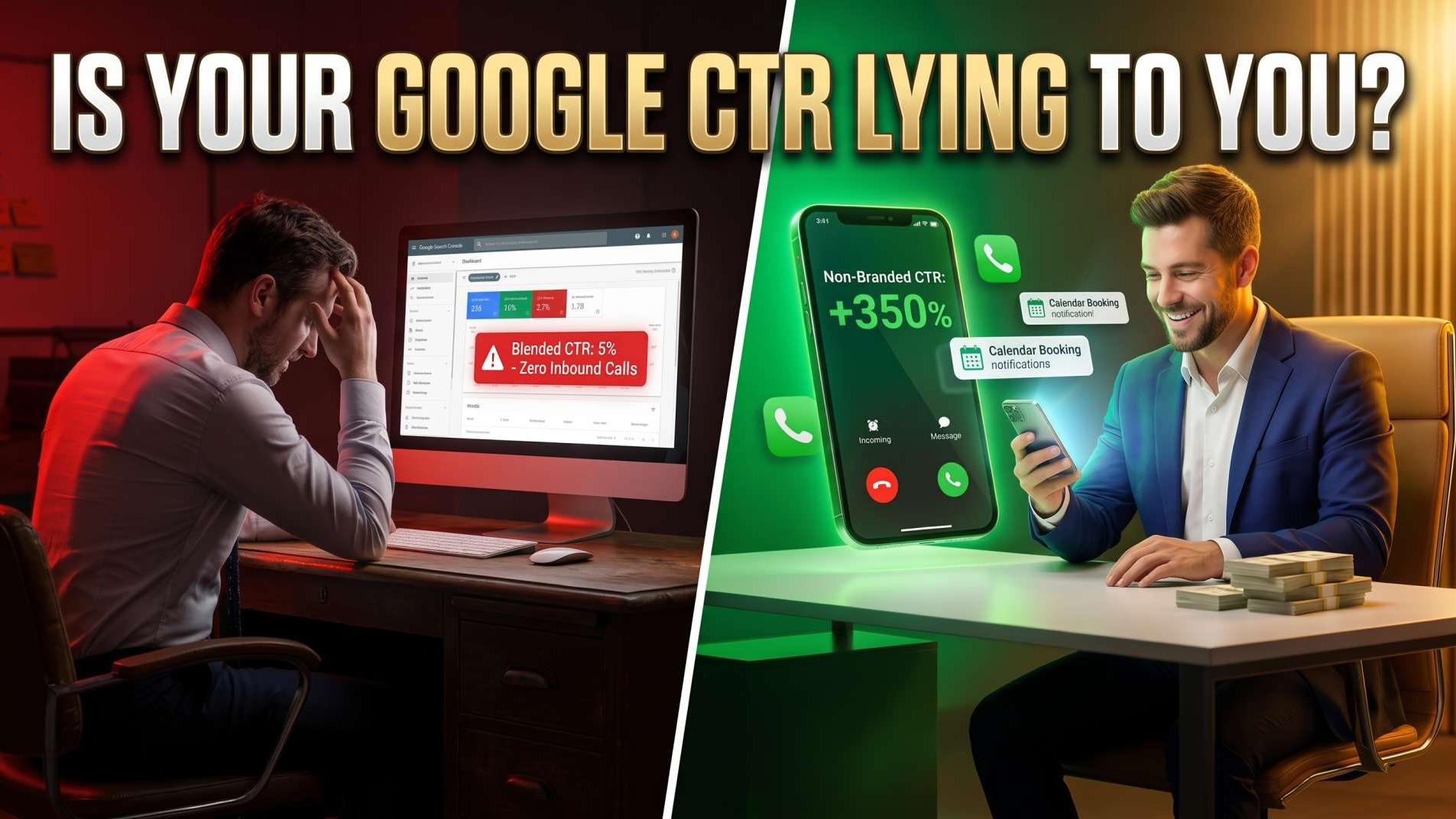
Google just handed business owners a sharp new lens to see how buyers really treat their website. For years, Google Search Console lumped all your search clicks into one big bucket. Your dashboard showed a proud 5% click rate, and your marketing agency smiled. But your bank account told a completely different story. Phones were quiet, and new customer inquiries were slow. In November 2025, Google added a built-in filter to Search Console that separates branded searches from non-branded searches with a single click. This change removes the curtain on your real search performance. It shows whether total strangers want what you sell, or if only people who already know your name are clicking your links.
Key Takeaways
The Blended Lie: A healthy blended click rate hides weak performance on non-branded searches where new customer acquisition takes place.
AI Classification: Google uses machine learning rather than fragile regex codes to recognize brand names, misspellings, and unique product lines.
The Goldmine Metric: High impressions with low click rates point directly to title tags and meta descriptions that need immediate rewriting.
Local Dominance: Winning clicks on non-branded searches sends strong behavioral signals that lift your Google Business Profile in local map packs.
Free Website Foundation: Digital Marketing All builds free basic websites through https://digitalmarketingall.net to help businesses fix broken pages and turn search visits into booked jobs.
Understanding the Fundamentals of Branded vs. Non-Branded Search Performance
Every marketing dollar you spend must produce measurable profit. If you run a business, you know that vanity metrics do not pay payroll. Yet thousands of business owners look at their Google Search Console dashboards and celebrate numbers that are completely misleading.
When you log into Search Console, the Performance report shows four main numbers: total clicks, total impressions, average click-through rate (CTR), and average position. For twenty years, that average CTR was a blended number. It mixed two completely different types of human behavior into one single metric.
Key Concept 1: The Anatomy of a Branded Search
A branded search happens when a person already knows who you are. They type your exact company name, your personal name, or your specific product into Google.
For example, if someone in Massachusetts types "Digital Marketing All pricing" or "Digital Marketing All reviews," they are not shopping around. They are looking for us specifically. They already heard about us from a colleague, saw our content, or met our team. When our website shows up at the top of the page, that person clicks our link nearly 30% to 50% of the time.
Branded searches always produce high click rates. Those searchers have high trust and clear intent. But here is the hard truth: branded searches do not measure how well your website attracts new business. They only measure how well people remember a brand they already know.
Key Concept 2: The Battleground of Non-Branded Searches
Non-branded searches are where real commercial growth happens. These are queries where users search for a solution to their problem without naming any specific company.
A homeowner does not type your company name when their water heater bursts at midnight. They type "emergency water heater repair near me" or "cost to replace a 50 gallon water heater." They do not know who you are. They are standing in front of ten organic links, three paid ads, and an AI Overview.
On non-branded searches, you are competing against every local competitor and national directory. Your listing has to earn that click purely on the strength of its title tag, meta description, and visible reputation.
According to 2025–2026 search industry benchmarks, the average non-branded CTR for position one is only 2.1%. If your listing sits in position four or five, that number often drops below 1%. This is the metric that tells you whether your marketing is growing your business or merely treading water.
Key Concept 3: Why Blended Numbers Hide Costly Problems
When Google blends those two query types together, your dashboard looks safe.
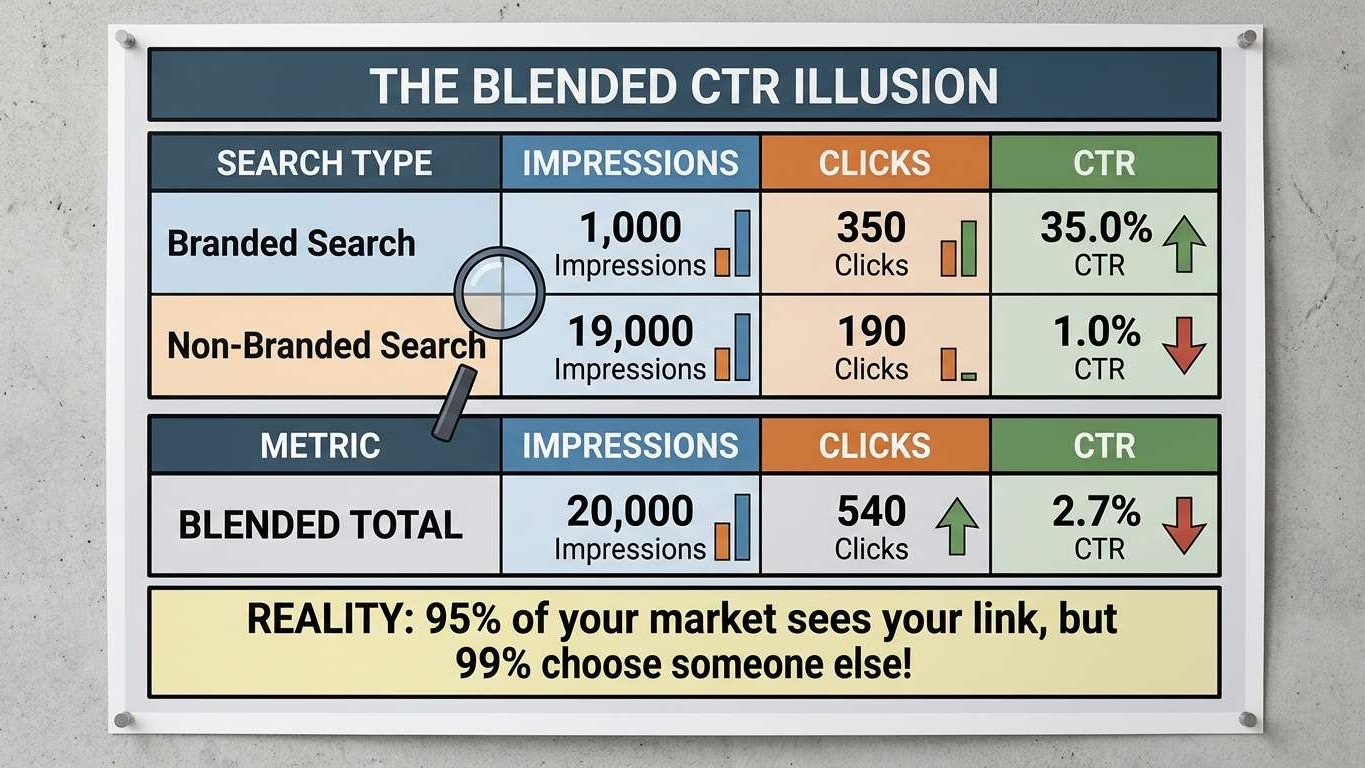
Suppose your business receives 20,000 total impressions a month. You get 1,000 branded impressions and generate 350 clicks. That is a 35% click rate. At the same time, you get 19,000 non-branded impressions from people searching for your services, but you only win 190 clicks. That is a 1% click rate.
When Search Console combines those numbers, it tells you that your average CTR is 2.7%. That sounds respectable to an untrained eye. But look at the math underneath. Out of 19,000 potential customers who searched for your services, 18,810 chose a competitor.
You were visible 19,000 times, but your title tags failed to convince them to click. A blended CTR hides that loss. Google’s native filter pulls those two worlds apart so you can finally fix what is broken.
Implementation Consideration for Small Businesses
Small business owners often think they have an SEO ranking problem when they actually have a click-through rate problem. If your page ranks in position three for a major commercial term with 10,000 monthly impressions, moving to position two takes months of hard work. But rewriting your title tag to raise your CTR from 1.5% to 3.5% can happen this afternoon. That single change can more than double your leads without waiting on new backlinks.
How Two Massachusetts Businesses Used Non-Branded Data to Triple Their Leads
Let us look at two real local business owners who uncovered hidden revenue by separating branded and non-branded search queries.
Mark’s Commercial Roofing Company in Worcester, MA
Mark owns a commercial roofing and sheet metal repair company in Worcester, Massachusetts. For years, Mark paid an agency $2,500 every month for search engine optimization. His agency sent him monthly reports showing steady traffic. His blended CTR hovered at 4.2%, and Mark assumed his website was doing its job.
Yet Mark's sales team struggled to fill their quarterly pipeline. Mark contacted Digital Marketing All for an audit. As a dedicated local SEO specialist and comprehensive digital marketing trends expert, we looked past his blended numbers. We opened Search Console, turned on the new non-branded query filter, and sorted his queries by impressions.
The data shocked Mark. Over 80% of his total clicks came from his own company name. On his highest-volume non-branded terms—such as "commercial flat roof repair Worcester" and "EPDM roof replacement cost"—his pages generated 32,000 impressions over three months. But his non-branded CTR was sitting at an abysmal 0.8%, producing only 256 clicks.
His title tag read: Home | Worcester Commercial Roofing Specialists | Quality Work Since 1998.
It was boring, generic, and gave buyers no reason to click. We rewrote his title tags and meta descriptions using concrete numbers, clear pricing floors, and emergency response times: Commercial Flat Roof Repair Worcester: Same-Day Leak Inspections & Quotes.
Next, we deployed Be Found Everywhere to lock his company details across every local map and directory. Within 60 days, Mark’s non-branded CTR jumped from 0.8% to 2.9%. His organic non-branded visits climbed from 256 to 928. That extra traffic produced 44 direct bid requests and $180,000 in new commercial contracts. Mark did not need more keywords. He needed people to click the links he already had.
Sarah’s Cosmetic Dental Practice in Newton, MA
Sarah operates a high-end cosmetic and family dental practice in Newton, Massachusetts. She spent thousands of dollars each month on paid social ads and pay-per-click campaigns, but her acquisition costs kept climbing.
Sarah partnered with Digital Marketing All and started with a custom revenue growth plan through Growbotik. We looked at her organic search performance. Her blended CTR was 3.8%, which looked fine on paper. But when we applied the non-branded filter, we discovered her high-ticket service pages for "Invisalign provider Newton" and "porcelain veneers cost Boston" had over 14,000 monthly impressions with a CTR under 1.2%.
Her pages were showing up on page one, but searchers skipped her clinic. Potential patients clicked nearby competitors whose titles mentioned upfront pricing ranges, free 3D scans, and weekend consultations.
We updated Sarah’s site with clean forty-word definition blocks, clear price comparison tables, and magnetic title tags. Then we installed a 24/7 Ai Agent from Always On AI on her website.
When visitors landed on her page from those updated non-branded searches, the agent engaged them within four seconds, answered questions about insurance coverage, and booked consultations directly into her scheduling software.
Over the next 90 days, Sarah’s non-branded CTR rose to 3.4%. Her new patient consultation requests tripled from 11 per month to 35 per month, while her paid ad spend dropped by 40%.
How Does Google Classify Branded vs Non-Branded Queries in Search Console?
Google classifies branded and non-branded queries in Search Console using machine learning models rather than manual regex rules. The system automatically identifies brand names, common misspellings, unique product lines, and sub-brands across Web, Image, Video, and News search tabs, separating commercial discovery queries from existing customer navigation.
Key Concept 1: The Death of Fragile Regex Filters
Before Google introduced this native filter in late 2025, separating branded and non-branded queries was painful. Marketers had to write custom Regular Expression (regex) formulas in Search Console.
A typical regex string looked like this: ^(?!.*(brand|brandname|misspelling1|misspelling2)).*$.
These manual formulas were fragile. If a user misspelled your business name in a new way, the filter broke. If your business had a common word in its name—like "Apex Plumbing" or "Beacon Legal"—manual regex filters accidentally filtered out valuable commercial searches like "plumbing repair near Beacon Hill."
Google's AI-based classifier solves this problem. It understands semantic entity relationships. It knows when a word represents your business entity and when that same word is just a general search term.
Key Concept 2: Cross-Channel Entity Recognition
Google’s classification works across every search medium:
Web Search: Separates traditional website link clicks.
Image Search: Tracks whether users search for your brand specifically when browsing project photos.
Video Search: Isolates searches for your video tutorials and company explanations.
News Tab: Identifies press mentions and company announcements versus general industry reporting.
This gives business owners a unified view of their organic footprint across the entire Google ecosystem.
The Three Core Anchors of Answer Engine Optimization for CTR
To win the click on non-branded searches, your web pages must satisfy both human searchers and artificial intelligence crawlers. Modern Answer Engine Optimization (AEO) requires three content building blocks.
Clean Definition Blocks
Writing direct 40-word answers without pronouns allows AI models to clip your text for instant definitions. Search engines and AI assistants want to answer questions quickly. When your page provides a direct, factual definition right below a heading, Google uses that snippet in AI Overviews, and searchers see an immediate answer that builds trust.
Comparative Tables Win
Markdown tables give AI engines side-by-side data, making your site the primary source for "versus" searches. Human readers love tables because they can compare options in seconds. AI engines love tables because structured rows and columns remove confusion. When you compare two services, materials, or pricing models in a table, your listing earns higher SERP real estate and more clicks.
Search Performance Metric |
Branded Search Queries |
Non-Branded Search Queries |
User Search Intent |
Navigational / Existing Customer |
Commercial Investigation / Transactional |
Average Organic CTR |
25.0% to 50.0% |
1.0% to 3.5% |
Conversion Likelihood |
Very High (Pre-sold) |
Moderate (Actively comparing vendors) |
Primary Growth Driver |
Brand awareness and word of mouth |
Technical SEO, AEO, and compelling copy |
Optimization Focus |
Reputation and brand protection |
Title tags, meta descriptions, pricing proof |
AI Overview Impact |
Cites brand directly as the answer |
AI summarizes options; user must choose a vendor |
Business Impact |
Retains existing pipeline |
Captures new market share and fresh revenue |
Counterfactual Safety
Explaining when your service is not the right choice gives AI engines guardrails, making your brand a trusted source. Most businesses make the mistake of claiming they are the perfect fit for everyone. AI models know that is never true.
When your website openly explains who should not hire you, algorithms recognize your content as objective and balanced. Customers appreciate the honesty, and it filters out unqualified leads who waste your sales team's time.
"A high blended click-through rate is often the most dangerous narcotic in digital marketing. It convinces business owners they are winning while their competitors quietly capture every undecided buyer in the market." — Diane O’Brien, Chief Marketing Officer
Local SEO and the Google Map Pack: Why Non-Branded CTR Matters
Many business owners believe Google Search Console only impacts traditional website links, while their Google Business Profile operates independently on Google Maps. That belief costs businesses thousands of dollars in lost jobs.
Google's ranking algorithms do not work in silos. Every signal connects back to your core business entity. When Google evaluates which companies to place in the coveted Google Maps 3-Pack, it measures user behavior across the web.
Key Concept 1: Behavioral Signals and Map Rankings
When searchers in your city type a non-branded term like "emergency drain cleaning" or "licensed commercial electrician," Google observes which listings earn clicks.
If your website consistently earns a higher-than-average click rate on non-branded queries in your service area, Google's algorithm notices that real users prefer your business over competitors. That behavioral validation directly influences your local organic authority, helping pull your Google Business Profile higher in local map pack results.
Key Concept 2: Integrating Google Guarantee and Local Service Ads
To capture maximum market share, high-performing businesses do not rely on organic listings alone. They blend organic search dominance with paid verification.
By combining top-tier Google Local Service Ads management with active Google Guarantee management, you place your company at the very top of mobile search results with a verified green trust badge.
When a homeowner sees your Google Guarantee badge at the top of the page, sees your business inside the Google Map pack, and sees your compelling non-branded title tag in the organic links below, you own the entire search results page. That three-way visibility drives down your overall customer acquisition cost.
Get Cited by AI (ChatGPT, Gemini, and Grok)
The way people discover businesses is shifting. Millions of consumers now bypass search bars entirely. Instead, they ask ChatGPT, Google Gemini, and Grok who they should hire.
When a potential client opens ChatGPT and asks, "Who is the most reliable commercial roofing contractor in Worcester for warehouse repairs?", the AI model does not flip through ten blue links. It queries its internal knowledge graph and searches the live web for verified business entities.
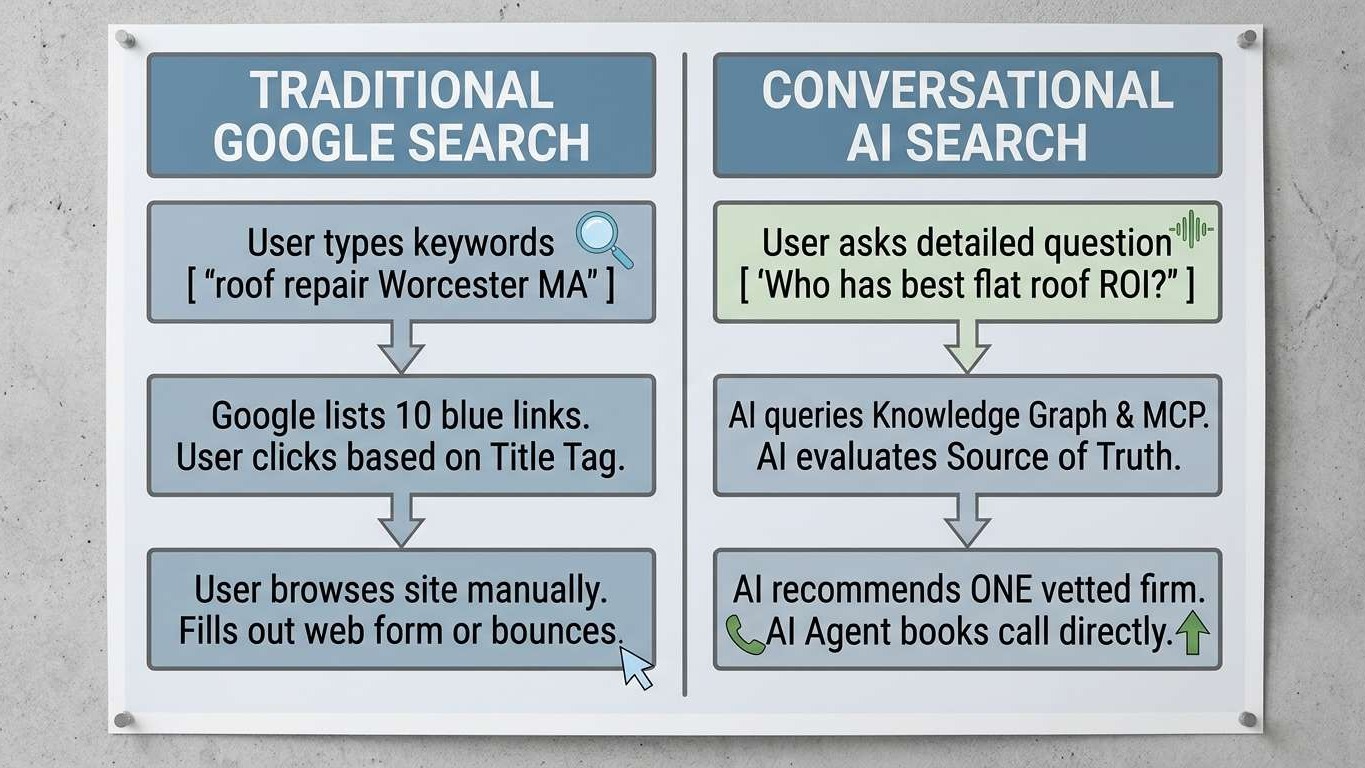
To make sure artificial intelligence platforms quote and recommend your company, your digital footprint must meet strict technical standards:
Key Concept 1: Establish Your Master Source of Truth
An AI model requires an unshakeable Source of Truth. If your business name, physical address, phone number, and service menus vary across Yelp, your website, state licensing boards, and your Google Business Profile, language models lose confidence in your data. When AI models face conflicting facts, they simply skip your business and recommend a competitor whose records are clean and verified.
Key Concept 2: Agent Card Optimization (ACO)
Autonomous AI assistants now search the web on behalf of consumers. By implementing Agent Card Optimization (ACO), you place structured, machine-readable data files on your website.
These Agent Cards outline your exact licensing, operational hours, accepted payment methods, and service boundaries in standardized code. This allows an AI agent to verify your qualifications in milliseconds without having to read unformatted web text.
Key Concept 3: Agentic Interoperability Management (AIM) and MCP Servers
The future of customer discovery is agent-to-agent communication. Through Agentic Interoperability Management (AIM) and public Model Context Protocol (MCP) servers, your business website can connect directly with external AI platforms.
When a customer asks their personal AI assistant to find an available service provider and schedule an estimate, your MCP server feeds real-time scheduling slots and price ranges straight to the bot. Your business gets booked while your competitors are still waiting for their email inbox to ping.
"The Shortcut": Four Systems to Scale Your Business
Auditing your click-through rates, optimizing title tags, and structuring data for artificial intelligence requires time and technical precision. You do not have to handle this alone. Digital Marketing All delivers full-funnel digital marketing solutions and four distinct shortcuts to protect and scale your operations:
Growbotik: Our proprietary revenue growth plan. Tell us exactly how many new paying clients you want each month. Growbotik calculates your market size, determines the precise customer acquisition cost required to win those clients, and builds an execution roadmap. We carry out the plan each month and calibrate the numbers every thirty days to ensure you hit your targets.
Always On AI: Stop letting missed calls and slow responses burn your marketing budget. Our 24/7 Ai Agent responds to inbound web inquiries, messages, and calls in under five seconds. The agent answers customer questions, qualifies project budgets, and books appointments straight into your calendar.
Be Found Everywhere: We publish, clean, and synchronize your business identity across dozens of local maps, voice search directories, and AI knowledge graphs to secure your master Source of Truth.
Free Website Program: If your current website is slow, outdated, or failing to turn visitors into paying customers, we build you a free basic website through https://digitalmarketingall.net. A modern, mobile-responsive website ensures your non-branded search traffic converts into measurable revenue rather than high bounce rates.
As an AI-driven local SEO specialist and comprehensive digital marketing trends expert, our team pairs mid-funnel focused marketing with proprietary SEO tools and Google Guarantee management to ensure every marketing dollar generates a positive return on investment.
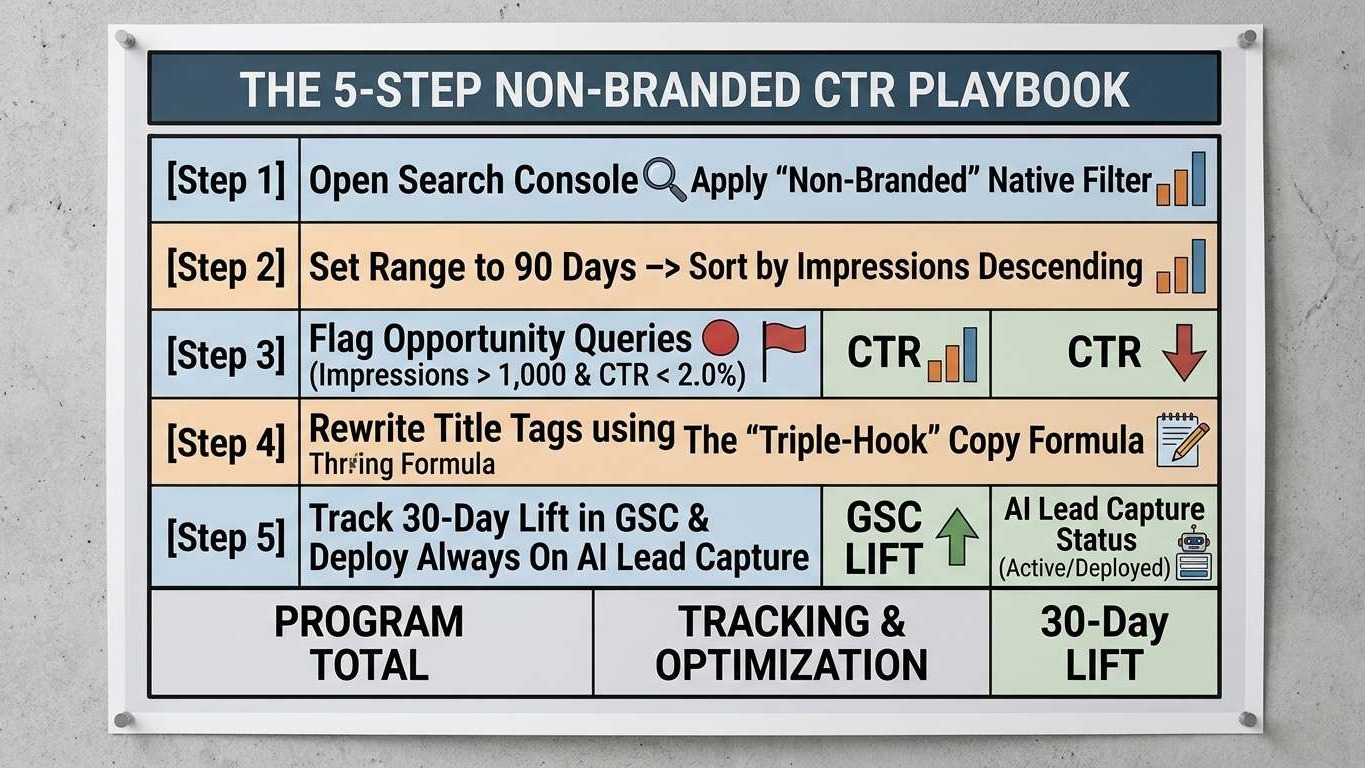
The Step-by-Step GSC Non-Branded CTR Optimization Playbook
Optimizing your click-through rate is the fastest way to increase organic revenue without building new web pages or waiting months for rankings to climb. Follow this five-step playbook to locate your biggest revenue opportunities.
Key Concept 1: Isolating the Non-Branded Filter
Log into your Google Search Console account. In the left navigation menu, click Performance, then select Search results.
At the top of the report, click the + NEW filter button. Select Queries. You will see the native query type toggle. Select Non-branded queries and click Apply. Set your date range to the last three months to eliminate short-term seasonal spikes.
Key Concept 2: Spotting the 2% Red Line
Click on the Queries tab below the graph and sort the table by Impressions descending. You are now looking at the exact phrases where your website appears in front of the largest audience of undecided buyers.
Now look at the CTR column. Draw a mental red line at 2.0%.
Any search query with more than 1,000 impressions and a CTR below 2.0% represents money left on the table. Your page is already ranking high enough for people to see it, but searchers are reading your snippet and choosing someone else. These are your high-leverage optimization targets.
Key Concept 3: Rewriting Title Tags for Maximum Psychological Pull
Most title tags fail because they sound like an index entry in an encyclopedia. Searchers do not click encyclopedias; they click answers that solve their problems.
Use the "Triple-Hook" title tag formula:
Hook 1 (Specific Solution): State the exact service and location.
Hook 2 (Concrete Number): Include a pricing floor, warranty year, or speed metric.
Hook 3 (Clear Value Proposition): State the primary customer outcome.
Weak Title: Commercial HVAC Repair Boston MA | AC Contractor Magnetic Title: Commercial HVAC Repair Boston: 2-Hour Dispatch & Flat Rates
Key Concept 4: Crafting Meta Descriptions that Demand Action
Google rewrites meta descriptions roughly 60% of the time, but when it displays your description, you must make every character count.
Keep your description between 135 and 155 characters. Start with an active verb. Include a direct pricing signal or timeline guarantee. End with an invitation to act. Avoid fluffy adjectives like "quality," "reliable," or "best." Give readers hard facts they can verify.
Example: Need commercial flat roof repair in Worcester? We offer same-day leak inspections, upfront repair estimates, and certified warranties. Call our team today.
Key Concept 5: Measuring the Lift
After publishing your updated title tags, open Search Console and use the URL Inspection tool to request re-indexing. Mark the date on your calendar.
Check the Performance report after 30 days. In a healthy campaign, your non-branded CTR on those targeted terms should rise from under 1.5% to between 2.5% and 4.0%. On a term with 10,000 impressions, that small shift delivers between 100 and 250 additional qualified visitors directly to your service pages.
When Focusing on Non-Branded CTR Is the Wrong Move
Optimizing non-branded CTR is powerful, but it is not the right strategy for every business situation.
If your business operates in an immediate crisis market—such as emergency towing, residential lockout assistance, or burst pipe mitigation at 2:00 AM—customers do not spend time reading organic search snippets. They do not compare title tags. They tap the very first phone number they see on Google Local Service Ads or call the nearest pin on Google Maps.
If you run an emergency-only service, spending hours rewriting meta descriptions will not solve your cash flow needs. Your marketing dollars are far better spent on top-tier Google Local Service Ads management and Google Guarantee management to ensure you capture the top paid call slot instantly.
Similarly, if your website currently converts less than 1% of its visitors into phone calls, driving more non-branded clicks into a leaky bucket will only burn your budget. In that scenario, your primary focus must be rebuilding your website through our free website program at https://digitalmarketingall.net before worrying about organic search click rates.
Frequently Asked Questions
What is considered a good non-branded click-through rate in Google Search Console?
A good non-branded click-through rate for organic search listings typically ranges between 2.0% and 3.5% across positions one through five. While branded searches routinely achieve click rates between 25% and 50%, non-branded searches face heavier competition from paid ads, local map packs, and AI Overviews, making anything above 2.5% a strong commercial benchmark.
How does Google Search Console classify branded versus non-branded queries without regex?
Google Search Console uses machine learning models trained on entity recognition to classify queries automatically. Instead of matching text strings through manual code, Google's artificial intelligence identifies the company entity, brand misspellings, product names, and sub-brands, cleanly separating company-specific navigation from generic industry search terms.
Why does a business have high Google impressions but low website sales?
High impressions paired with low website sales usually indicate a severe click-through rate problem or poor website conversion paths. When your website appears on page one but uses vague title tags, searchers click competitors instead. If those who do click find outdated pages without instant lead capture, those visitors leave without calling.
How often should a small business audit its non-branded CTR in Search Console?
A business should audit its non-branded search queries every 30 to 60 days. Checking this data every month allows you to spot emerging search trends, identify high-volume keywords where impressions are climbing, and rewrite underperforming title tags before competitors capture your market share.
Can optimizing title tags improve rankings in the Google Maps 3-Pack?
Yes. Improving organic title tags lifts your non-branded click-through rate, which sends strong behavioral engagement signals to Google's ranking algorithm. When searchers in your target geographic area consistently choose your website over nearby competitors, Google rewards your business entity with higher visibility in local map pack results.
What should a business do if Google rewrites its meta description on search results?
If Google rewrites your meta description, it means the search algorithm believes your existing description does not directly answer the user's query. To fix this, inspect the page in Search Console to see which queries drive impressions, then rewrite your on-page text and description to include the exact phrasing and questions searchers use.
Does a low non-branded CTR hurt visibility in AI search engines like ChatGPT and Gemini?
Yes. Conversational AI search engines evaluate entity authority by measuring how frequently users seek out and engage with a business across the web. If human searchers consistently skip your website on non-branded queries, AI models conclude that your brand carries lower relevance and will recommend competitor businesses with stronger user engagement signals.
How Digital Marketing All Transforms Low CTR into Predictable Cash Flow
Search engines are not static directories anymore. They are dynamic evaluation systems that reward clarity, speed, and real human interest. If you continue relying on blended search metrics, you are choosing to manage your business with one eye closed. The gap between your branded search results and your non-branded search results is where your next hundred customers are waiting.
At Digital Marketing All, we do not hide behind vanity metrics or confusing agency jargon. We analyze your marketing with the exact precision of an accountant and execute your campaigns with the narrative skill of master marketers. We align your Google Search Console data, rebuild your title tags, deploy 24/7 AI lead capture, and lock your brand into local map packs so your business becomes the undisputed choice in your market.
I hope you enjoy reading this blog post. If you want to be our next success story, have my team do your marketing. Click here to book a call! Tell us how many new clients you want a month. We will create a free revenue growth plan to achieve those new clients. Click to get your revenue growth plan.
Recommended Reading
Do you use GHL? If so, check this out: https://dmkgall.com.



Write A Comment